
In This Article
Picture this: you’re three days into a canoe trip in Algonquin, your hair is soaked from a surprise rain squall, and the nearest outlet is somewhere back in the parking lot you left on a Tuesday. This is the exact moment a battery powered hair dryer stops being a novelty gadget and starts being the small piece of gear you’re genuinely grateful you packed. Over the past few years, cordless drying tech has quietly gone from “gimmick you’d find in a dollar store bin” to a legitimately useful category, especially for campers, cottage-goers, and anyone who’s ever stood in a hotel bathroom in rural Nova Scotia wondering why the only outlet is across the room from the mirror.

A battery powered hair dryer is a handheld dryer that runs on an internal rechargeable battery (usually lithium-ion or lithium-polymer) instead of a wall cord, letting you dry and style hair anywhere — RVs, campsites, dorms, or off-grid cabins with no reliable power. That’s the whole pitch in one sentence, and it’s a genuinely useful one if you know what you’re buying.
Here’s the honest bit up front, though, because that’s what this whole article is built on: these things trade outlet dependence for a battery, and batteries have limits that a corded dryer never has to think about. So before you toss one in your cart, it helps to actually understand the wattage, runtime, and charging trade-offs — which, conveniently, is what we’re about to dig into. We’ve also looked at how Transport Canada treats lithium batteries carried in aircraft cabin luggage, since that matters more than you’d think if you’re flying with one of these.
Below, we’ve researched seven real, currently available battery powered hair dryer models sold through amazon.ca, broken down what their specs actually mean for your hair (not just what’s printed on the box), and built out buyer frameworks for campers, parents, and anyone who’s simply done with fighting for outlet space.
Quick Comparison Table
| Model | Power Output | Battery | Best For |
|---|---|---|---|
| Vikye Cordless Hair Dryer | 200W | 15,000mAh | Best all-rounder |
| fosa Cordless Hair Dryer | 200W | 15,600mAh | Best value pick |
| YALICE Cordless Hair Dryer | ~180-200W | 15,000mAh | Best tech-forward pick |
| SL Nevnmoe Cordless Hair Dryer | ~180-200W | 15,000mAh | Best for camping & RVs |
| WanFei Portable Hair Dryer | Low-wattage | 8× AA batteries | Best AA-battery backup |
| GRGE Foldable Hair Dryer | 500W | Built-in rechargeable | Best for kids & pets |
| VOLO Go Cordless Hair Dryer | Infrared element | Removable Li-ion pack | Best premium splurge |
Look closely at that battery column and a pattern jumps out: most budget and mid-range cordless dryers have converged on roughly the same 15,000mAh lithium cell, which tells you it’s likely close to the practical ceiling manufacturers have found for a handheld unit that still fits in a bag. The WanFei Portable Hair Dryer is the outlier, running on swappable AA cells instead of a sealed battery — a real advantage if you’re camping somewhere you can’t recharge anything but can easily restock batteries. Meanwhile, the VOLO Go Cordless Hair Dryer breaks the mould entirely by pairing a removable battery pack with an infrared heating element rather than a standard coil, which is exactly why it costs roughly ten times what the others do.
💬 Just one click — help others make better buying decisions too!😊
Top 7 Battery Powered Hair Dryers: Expert Analysis
1. Vikye Cordless Hair Dryer — best all-rounder for everyday cordless use
The Vikye Cordless Hair Dryer earns its “all-rounder” tag by simply covering more bases than most of its rivals. It’s built around a 15,000mAh lithium battery and a 200W motor with airflow multiplier technology, and it comes with hot and cold settings plus three wind speeds, which is more flexibility than you’d expect at this price tier.
Here’s what that 200W figure actually means in practice: it’s roughly a seventh of what a plugged-in 1,875W dryer pushes out, so don’t expect a five-minute blowout. What you get instead is steady, adjustable airflow that’s genuinely enough for short-to-medium hair, especially when you use the hot setting for the bulk of drying and finish with a cool shot to set your style. Based on the spec comparison with similar cordless units, the metal body construction here is also a small but real durability edge — plastic housings on cheaper alternatives tend to develop hairline cracks around the motor housing after repeated travel.
Reviewers consistently note that the multiple nozzle attachments (including an oddball hammer-shaped one meant for broader-area drying) add genuine versatility beyond hair — some buyers use it for quick-drying small painted surfaces or camping gear. A common complaint in user reviews is that the display screen, while a nice touch, can be hard to read in direct sunlight, which matters if you’re using this outdoors at a campsite.
Pros:
- ✅ Hot and cold settings plus 3 wind speeds in one unit
- ✅ Metal body holds up better to travel wear and tear
- ✅ Multiple nozzle attachments add real versatility
Cons:
- ❌ Display screen is hard to read in bright daylight
- ❌ 200W output means longer dry times than corded models
At the time of research, the Vikye Cordless Hair Dryer sits in the C$45-C$65 range, and prices may vary — for the feature set, that’s a fair value verdict for anyone who wants one cordless dryer to handle both home backup duty and camping trips.

2. fosa Cordless Hair Dryer — best value pick for casual travellers
If your priority is simply “get a working cordless dryer without overthinking it,” the fosa Cordless Hair Dryer is the pick that keeps things refreshingly uncomplicated. It runs a 200W motor off a 15,600mAh battery, charges via USB-C (a small detail that matters more than it sounds, since it means one cable does double duty for your dryer and your phone), and offers both hot and cool airflow.
What most buyers overlook about USB-C charging specifically is that it usually charges faster and more reliably than older micro-USB setups found on some competing budget dryers, because USB-C supports higher power delivery. In practice, that shaves real time off your pre-trip charging routine. The 15,600mAh cell is marginally larger than the Vikye’s, though in day-to-day use the difference in total drying sessions per charge is modest — both land in a similar one-to-two-session range depending on hair length and heat setting.
Aggregated review sentiment around fosa’s cordless lineup tends to praise the lightweight build for travel bags, while a recurring theme in feedback is that the airflow, while adequate, isn’t going to replace a full-power salon dryer for anyone with thick or long hair. That’s a fair trade-off given the price point, and it’s honestly true of nearly every dryer in this category, not just this one.
Pros:
- ✅ USB-C charging is faster and more universal
- ✅ Genuinely lightweight for packing in carry-on bags
- ✅ Straightforward hot/cool controls, no learning curve
Cons:
- ❌ Airflow is modest for thick or long hair
- ❌ No digital display to track remaining charge
Priced around C$35-C$50 at the time of research (check current price, as availability shifts), the fosa Cordless Hair Dryer delivers solid value for anyone whose main use case is dorms, short trips, or the occasional power outage.
3. YALICE Cordless Hair Dryer — best tech-forward pick with a digital screen
The YALICE Cordless Hair Dryer distinguishes itself with a small digital display screen and a magnetic nozzle attachment system, plus four operating modes rather than the usual two or three. On paper this means more granular control over heat and airflow combinations, and in practice it does deliver a noticeably more “dialed-in” experience than the more basic units on this list.
Here’s what most buyers overlook about that digital screen: it’s not just a gimmick, it typically shows remaining battery percentage in real time, which solves one of the most common frustrations with cordless dryers — not knowing if you have five minutes or twenty-five left mid-dry. The magnetic nozzle is another small but meaningful upgrade; it snaps on and off far more reliably than the friction-fit nozzles found on cheaper models, which tend to loosen and fall off with repeated use.
Reviewers consistently report that the 15,000mAh battery performs comparably to other units in this wattage class, so the value-add here isn’t raw power, it’s the user experience layer sitting on top of similar hardware. A recurring theme in aggregated feedback is that the four modes take a session or two to get used to, since the button sequence to cycle through them isn’t always intuitive on first use.
Pros:
- ✅ Digital battery percentage display, no more guessing
- ✅ Magnetic nozzle attaches more securely than friction-fit
- ✅ Four modes give finer heat and speed control
Cons:
- ❌ Mode-cycling button sequence isn’t intuitive at first
- ❌ Premium features add a modest price bump over basics
At the time of research, expect to pay somewhere in the C$50-C$70 range for the YALICE Cordless Hair Dryer — a reasonable premium if a battery readout and secure attachments matter to you.
4. SL Nevnmoe Cordless Rechargeable Hair Dryer — best dedicated pick for camping, travel, and RVs
Built and marketed explicitly around travel, camping, and RV use, the SL Nevnmoe Cordless Rechargeable Hair Dryer runs a 15,000mAh battery with three adjustable hot and cold air settings, and its whole design philosophy is “assume you won’t have an outlet.” That’s a meaningfully different starting point than dryers designed primarily for home use with cordless as a bonus feature.
What that focus buys you in practice is a build that leans toward compactness and simplicity over flashy extras — there’s no digital screen or app to fuss with, just a dial or button set that gets you drying quickly, which matters when you’re standing at a campsite picnic table and just want warm(ish) hair before the bugs come out. Based on the spec comparison with the rest of this list, the three-setting system splits the difference nicely between the two-setting basics and YALICE’s four-mode complexity.
A common theme in aggregated reviews for RV- and camping-marketed cordless dryers like this one is that users specifically appreciate not needing an inverter running off their vehicle battery just to dry their hair — something anyone who’s actually tried running small appliances off an RV’s 12V system will immediately understand the value of. If you’re researching options specifically for backcountry or car-camping trips, it’s worth cross-referencing Parks Canada’s camping and accommodations guide for what kind of power access (if any) to realistically expect at your destination before assuming a cordless dryer alone solves the problem.
Pros:
- ✅ Purpose-built for camping, travel, and RV scenarios
- ✅ Simple three-setting control, no learning curve
- ✅ Compact enough for tight RV or tent storage
Cons:
- ❌ No digital display for battery tracking
- ❌ Fewer styling modes than tech-forward competitors
At the time of research, this model runs around C$40-C$60, prices may vary — for dedicated campers, the value verdict is strong given how squarely it’s built for exactly this use case.
5. WanFei Cordless Portable Battery Powered Hair Dryer — best AA-battery backup for true off-grid use
This is the pick that answers a very specific question: what if you don’t want to rely on recharging anything at all? The WanFei Cordless Portable Battery Powered Hair Dryer runs on eight standard AA batteries rather than a sealed lithium cell, delivering roughly 50 minutes of drying time per set according to published specs, and it also includes a standard plug option for dual-power flexibility.
Here’s what that AA-battery design means in practice: you trade some convenience (batteries add weight and eventually cost more per use than recharging) for a genuine off-grid advantage — you can restock AA batteries at literally any gas station or general store in rural Canada, whereas a dead lithium pack with no outlet nearby is simply dead until you find power. That makes this one of the few options on the market that’s honestly “grid-independent” rather than just “cordless until the battery runs flat.”
We should note honestly here that specific, verified customer review data for this exact AA-battery configuration is thinner than for the more mainstream lithium-battery models above, since it occupies a smaller niche of the market; what we can confirm is the published spec of eight-AA operation for around 50 minutes, sourced from manufacturer and retailer listings, and we’d encourage checking current buyer feedback on the amazon.ca listing itself before purchasing. Reviewers of similar dual-power, removable-battery dryers do commonly note that the plug-in mode performs like a standard low-wattage travel dryer, with the battery mode reserved as an emergency backup rather than a daily driver.
Pros:
- ✅ Runs on universally available AA batteries
- ✅ Dual power: batteries or standard plug
- ✅ True off-grid reliability, no recharge cycle needed
Cons:
- ❌ AA batteries add ongoing cost versus rechargeable cells
- ❌ Verified review volume is thinner than mainstream models
Pricing sits in the C$30-C$45 range at the time of research, making it an inexpensive insurance policy for anyone genuinely worried about being caught without any power source at all.
6. GRGE Foldable Battery-Powered Hair Dryer — best for families with kids and pets
The GRGE Foldable Battery-Powered Hair Dryer takes a different angle entirely, built around a 500W motor with a high-speed brushless design and air-multiplier technology, but engineered specifically for gentle, low-temperature airflow suited to babies, kids, and pets. Published specs list working time up to 6-8 minutes on the higher-speed low-heat setting, or as long as 100 minutes on the low-speed cool-wind setting.
That gap between the two runtimes is the whole story here, and it’s worth spelling out: what the spec sheet won’t tell you outright is that this dryer is essentially two different tools depending on the setting you choose. On low-speed cool wind, it’s built for extended, gentle use — ideal for calming a fussy toddler’s hair-drying routine or drying a nervous dog after a bath without overheating sensitive skin. On the higher-speed setting, the shorter runtime reflects the extra battery draw needed to push more air faster, which is the trade-off you’d expect from any battery-powered appliance.
A recurring theme in aggregated feedback for baby- and pet-focused cordless dryers in this category is genuine appreciation for the foldable handle, since it means less bulky storage in an already crowded diaper bag or pet-grooming kit. Reviewers also commonly flag that this style of dryer isn’t meant to compete on raw drying speed with adult-focused models — it’s optimized for safety and gentleness first.
Pros:
- ✅ Long 100-minute runtime on gentle cool-wind mode
- ✅ Air-multiplier tech built for kid- and pet-safe airflow
- ✅ Foldable design saves space in bags and kits
Cons:
- ❌ Shorter runtime on the higher-speed heat setting
- ❌ Not designed for fast adult-hair drying sessions
At the time of research, this model is priced around C$40-C$65, and for parents or pet owners specifically, the value verdict favours gentleness and portability over raw drying power.
7. VOLO Go Cordless Hair Dryer — best premium splurge with infrared heat
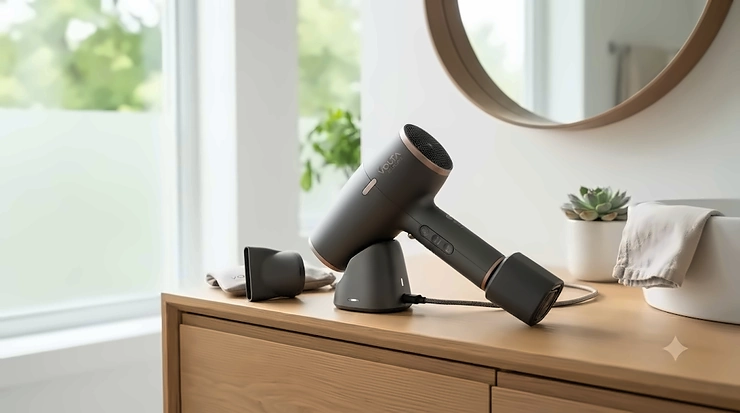
At the top of this list sits the VOLO Go Cordless Hair Dryer, a genuinely different category of product built around infrared heating technology rather than the standard heating-coil approach every other dryer here uses, paired with a removable lithium-ion battery pack and a charging base that doubles as a small vanity accessory.
Here’s where honesty matters most, because published sources genuinely disagree on this model’s real-world runtime — some manufacturer and retail listings cite a recharge time around 90 minutes with a multi-session battery life, while independent hands-on reviews report a more modest 13-to-25-minute working runtime per charge depending on heat setting, and a fuller 2-to-3-hour recharge cycle. Rather than pick whichever number sounds better, we think buyers deserve that full range, because it changes how you’d plan around this dryer: if you have short-to-medium hair, independent reviewers suggest a single charge is genuinely enough for a complete style; if you have long or thick hair, you may need to work efficiently or keep the charging base within reach.
What the infrared technology means in practice is that it heats hair from within the strand using radiant heat rather than just blasting hot convected air across the surface, which several independent reviewers describe as noticeably gentler on hair over time, with less of the frizzy, over-dried feeling that high-heat convection dryers can leave behind. That said, at roughly $450 USD (in the mid-C$600s once converted, though check current price as exchange rates and Canadian retail pricing can differ from a straight conversion), this is unambiguously a premium purchase, and reviewers are candid that the unit itself is noticeably heavier than a typical dryer, which some find fatiguing during longer styling sessions.
Pros:
- ✅ Infrared heat is gentler on hair than standard coils
- ✅ Removable battery pack simplifies future replacement
- ✅ Includes a genuinely useful charging/vanity base
Cons:
- ❌ Heavier in hand than most standard hair dryers
- ❌ Reported runtime varies significantly by source
At the time of research, expect to pay in the mid-C$600s for the VOLO Go Cordless Hair Dryer — a splurge that makes the most sense for anyone prioritizing hair health and willing to trade raw speed and light weight for gentler, infrared-based drying.
Practical Usage Guide: Getting the Most from Your Cordless Dryer
Getting a battery powered hair dryer home is the easy part. Getting good results out of it takes a slightly different approach than you’re used to with a corded model, mostly because you’re now managing a finite energy budget instead of an endless supply from the wall.
Start with a full charge cycle before first use, and don’t rush it — most of these units ask for 2 to 4 hours on the initial charge, and skipping ahead can leave the battery undercharged in a way that shortchanges your very first drying session. Towel-dry your hair more aggressively than you might with a corded dryer; since wattage is inherently lower here, you’re not going to blast away excess moisture the way a 1,875W salon dryer would, so getting hair to “damp” rather than “dripping” before you switch the unit on meaningfully cuts your total runtime needs. Section your hair if it’s thick or long, working in smaller chunks so the lower airflow has time to actually do its job on each section rather than skimming across everything at once.
A common first-30-days mistake is treating the cold-air setting as an afterthought — in reality, alternating a burst of warm air with a cooling shot near the end of each section helps seal the hair cuticle and actually extends how “finished” your style looks, all while drawing less power than running hot air continuously. Another frequent misstep: letting the battery run down to near-empty repeatedly before recharging. Lithium batteries generally prefer partial-charge cycles over full depletion, so topping up after each use (rather than waiting until it’s nearly dead) tends to preserve capacity longer over the unit’s lifespan.
For maintenance, keep the intake vents free of hair and dust — a clogged intake forces the motor to work harder, which drains the battery faster and generates more heat inside the housing than the design intends. Wipe down nozzles and the exterior casing after outdoor or camping use especially, since dust and sand are far more abrasive on seals and vents than typical bathroom humidity.
Real-World Scenarios: Who Actually Needs One of These
The weekend camper. Someone heading out most long weekends from spring through fall, tent camping at provincial parks with basic or no electrical hookups, generally on a modest gear budget. For this profile, either the SL Nevnmoe Cordless Rechargeable Hair Dryer or the AA-powered WanFei Cordless Portable Battery Powered Hair Dryer makes the most sense — the SL Nevnmoe if you’re diligent about recharging gear before each trip, the WanFei if you’d rather toss a spare pack of AAs in your camp box and never think about it again.
The parent with young kids (and maybe a dog). Frequency of use is high (daily or near-daily), environment is almost always indoors at home, and the priority isn’t speed, it’s gentleness and safety. The GRGE Foldable Battery-Powered Hair Dryer fits this profile closely, given its low-heat design and genuinely long runtime on the cool-wind setting, plus a foldable form factor that tucks easily into a diaper bag or pet-grooming kit for trips to grandma’s.
The frequent flyer who cares about hair health. Travels often for work, has a moderate-to-high budget, and has increasingly gravitated toward premium hair tools that prioritize long-term hair condition over sheer speed. This is squarely the VOLO Go Cordless Hair Dryer‘s audience — someone who already spends on quality hair products and views infrared drying as a reasonable extension of that investment, and who values a compact charging base that looks fine sitting on a hotel counter or home vanity alike.
How to Choose a Battery Powered Hair Dryer
- Start with your typical hair length and thickness. Long or thick hair needs either higher wattage or more patience with a lower-wattage unit; short or fine hair does fine with almost anything on this list.
- Match battery type to your actual use case. Rechargeable lithium cells (like the 15,000mAh units above) suit anyone with regular access to USB power; AA-based designs suit true off-grid situations where recharging isn’t realistic.
- Check the number of heat/speed settings against how much control you actually want. More modes aren’t automatically better if you’ll only ever use two of them.
- Weigh runtime against your typical drying session length. If you regularly need 15+ minutes of continuous hot air, a unit rated for shorter bursts will frustrate you fast.
- Consider portability requirements realistically. A folding handle and light weight matter enormously for backpacks and carry-on bags, less so for a unit that mostly lives in a bathroom drawer.
- Factor in who else will use it. Households with kids or pets benefit from dedicated low-heat, gentle-airflow designs rather than adapting an adult-focused unit.
- Decide your ceiling on price versus expected lifespan. Budget units are genuinely fine for occasional or backup use; if this becomes your primary daily dryer, the durability and features of a mid-range or premium pick tend to pay off.

Battery Powered Hair Dryer vs Traditional Corded Hair Dryer
The core trade-off here isn’t complicated, but it’s worth spelling out plainly because marketing copy rarely does. A traditional corded hair dryer, even a modest one, typically runs 1,600W to 1,875W, delivering dramatically faster drying and higher sustained heat than any battery unit currently on the market. That’s simply physics: a wall outlet supplies continuous, essentially unlimited current, while a battery has to store and release a fixed, finite amount of energy in a package small enough to hold comfortably.
What that means for you in practice is that a corded dryer will always win on raw speed and power for daily home use. Where the battery powered hair dryer category wins decisively is anywhere a cord simply isn’t an option — camping, RVs, off-grid cabins, power outages, or destinations with incompatible outlets and voltages. Reviewers consistently frame cordless dryers as a “second dryer” purchase rather than a full replacement, and that’s honestly the correct way to think about the category: buy one to solve a specific portability problem, not to replace your existing bathroom dryer outright.
There’s also a subtler difference in noise and heat consistency. Battery units, running lower wattage motors, tend to be noticeably quieter than high-power corded dryers, which some users specifically appreciate for early-morning use in shared spaces like dorms or thin-walled cottages. On the flip side, that lower power means longer total drying time, so the “quieter but slower” trade-off is consistent across nearly every model we researched.
Common Mistakes When Buying a Battery Powered Hair Dryer
One of the most frequent mistakes buyers make is assuming a cordless dryer will fully replace their existing corded one, then feeling disappointed when drying takes noticeably longer. Setting that expectation correctly before purchase avoids a lot of buyer’s remorse. Another common misstep is ignoring the charging cable type entirely — older micro-USB designs charge more slowly and are gradually being phased out, so a USB-C unit like the fosa Cordless Hair Dryer genuinely future-proofs your purchase better than it might first appear.
Buyers also frequently overlook battery chemistry warnings printed in the manual, particularly around temperature exposure. Leaving a lithium battery-powered dryer in a hot car trunk during summer travel, for instance, can degrade the cell faster than normal use ever would. A further mistake is buying based purely on mAh rating without considering wattage — a higher mAh number doesn’t automatically mean faster drying if the motor’s wattage is lower, since mAh reflects battery capacity while wattage reflects power draw; the two numbers answer different questions.
Finally, some shoppers skip checking the return policy or warranty terms on lesser-known brands entirely, which matters more here than with mainstream corded dryers, since much of this category is dominated by smaller manufacturers rather than the household names you’d recognize from drugstore shelves.
What to Expect: Real-World Performance
Translating spec sheets into lived experience is really the heart of this whole category. In practice, most 200W-class lithium battery dryers on this list will get short-to-medium hair from damp to “presentable” in roughly 8 to 12 minutes of active drying time, assuming you’ve towel-dried aggressively beforehand. Long or thick hair pushes that closer to 15-20 minutes, and some units simply won’t have the battery runtime to finish a single continuous session for very long or very thick hair without a recharge break.
Heat output, similarly, tends to feel noticeably gentler than a corded dryer’s high setting — that’s partly a safety feature (lower wattage means lower peak temperatures) and partly just an unavoidable consequence of battery-powered heating elements. Reviewers across this category consistently describe the experience as “adequate, not impressive,” which, read charitably, is exactly what you should expect from a portable backup tool rather than your primary daily driver.
Noise levels are a pleasant surprise for most first-time buyers moving from a powerful corded dryer — the lower-wattage motors in these units run noticeably quieter, which matters if you’re drying your hair in a shared dorm room or a tent-adjacent camp shower stall at 6 a.m. without waking up your camping neighbours.
Off-Grid Hair Care: Battery Powered Solutions for Campers and Cottage Country
For anyone spending real time away from reliable power — deep backcountry trips, remote cottages without grid electricity, or extended RV travel through Canada’s more sparsely serviced regions — a battery powered hair dryer solves a genuinely practical problem rather than a luxury one. Basic personal hygiene and hair care don’t have to disappear just because you’ve traded your bathroom for a tent vestibule.
The realistic off-grid hair care setup usually pairs one of the rechargeable lithium units (like the SL Nevnmoe Cordless Rechargeable Hair Dryer) with a portable power bank or solar charger, letting you top up the dryer’s battery even multiple days into a trip with no wall outlet in sight. For truly extended off-grid stretches, the AA-battery WanFei Cordless Portable Battery Powered Hair Dryer sidesteps the recharging question entirely, provided you’ve packed enough spare batteries. Before any backcountry trip, it’s worth reviewing Parks Canada’s camping and accommodation resources to understand what services, if any, a given campground actually provides, since assumptions about outlet access at “frontcountry” sites don’t always hold at more remote or backcountry locations.
Cold-weather camping adds one more wrinkle worth knowing: lithium batteries lose capacity temporarily in cold temperatures, so a dryer that ran fine on a summer trip may show a shorter runtime on a shoulder-season camping trip in October. Keeping the unit insulated in your pack overnight (rather than leaving it in an unheated vehicle) helps preserve its usable charge for morning use.
Long-Term Cost & Maintenance
| Consideration | Rechargeable Lithium Models | AA-Battery Models |
|---|---|---|
| Ongoing cost | Electricity only (negligible) | Recurring AA battery purchases |
| Lifespan | 2-4 years typical, battery degrades over time | Dryer body often outlasts multiple battery cycles |
| Replacement cost | Often cheaper to replace unit than battery alone | Batteries replaceable individually and cheaply |
| Best For | Regular home/travel use | True off-grid backup |
Looking at the table above, rechargeable lithium models like the Vikye Cordless Hair Dryer or YALICE Cordless Hair Dryer carry essentially no ongoing cost beyond the electricity to recharge them, but their internal batteries do degrade with age and heavy use, and most budget units aren’t designed with user-replaceable cells, meaning the whole unit typically gets replaced rather than repaired. The WanFei Cordless Portable Battery Powered Hair Dryer, by contrast, accrues a small recurring cost in AA batteries over time, but that cost is predictable and the dryer itself isn’t dependent on a single battery’s health curve.
✨ Don’t Miss These Exclusive Deals!
🔍 Take your cordless hair care routine to the next level with these carefully selected picks. Click on any highlighted item to check current pricing and availability. These tools will help you keep your hair care routine going strong, wherever your next trip takes you!

Safety, Regulations, and Battery Compliance in Canada
Battery powered hair dryers fall under the same general consumer product safety framework as any small electrical appliance sold in Canada, which means manufacturers are expected to meet recognized safety standards (commonly assessed against CSA or equivalent certification marks) before these products reach store shelves, whether physical or online. Health Canada actively monitors consumer product safety issues, including recalls tied to hair dryers specifically — a useful reminder that “hair dryer” as a product category isn’t automatically low-risk just because it feels like an everyday item.
It’s worth noting honestly that Health Canada’s public recall database does include past hair dryer recalls — one 2020 recall involving a hair dryer and diffuser flagged a missing immersion-protection plug as an electric shock risk — underscoring why buying from reputable listings with visible certification markings matters, even in the battery powered category where the risks (no mains current, no cord to fray) are generally lower than with corded units.
On the battery side specifically, lithium cells inside these dryers are classified as the same general battery type subject to air travel restrictions — carry them in cabin luggage rather than checked bags if you’re flying, and avoid exposing them to extreme heat or physical damage, since punctured or swollen lithium cells pose a genuine fire risk regardless of what device they’re inside.
Features That Actually Matter (And Those That Don’t)
Not every spec on a cordless dryer’s box is equally important, and separating genuine value from marketing filler saves you money and disappointment. Battery hair dryer wattage output is the single most important number to actually understand: it directly determines both drying speed and maximum heat, and most units in this category sit somewhere between 180W and 500W, versus 1,600W-plus for a typical corded dryer. Higher wattage within this category (like the 500W GRGE Foldable Battery-Powered Hair Dryer) genuinely does dry faster, but often at the cost of shorter overall runtime per charge, since more wattage draws more current from the same battery.
Battery capacity (mAh), by contrast, tells you how long the unit can sustain that wattage, not how powerful it is — a common point of confusion. A digital charge display, like the one on the YALICE Cordless Hair Dryer, is a genuinely useful feature rather than a gimmick, since it removes the guesswork of “how much drying time do I actually have left.” Magnetic nozzle attachments are a small but real quality-of-life upgrade over friction-fit ones, especially for anyone who’s ever had a nozzle pop off mid-dry.
On the “doesn’t matter as much as it sounds” side: flashy colour options, marketing language like “ionic technology” on ultra-budget units (the actual ion output on cheap cordless models is typically far lower than on premium corded dryers, so treat this as a nice-to-have rather than a deciding factor), and oversized accessory bundles that pad out the box without adding functional value to your actual drying routine.
FAQ
❓ How long does a battery hair dryer last on one charge?
❓ Can you bring a battery powered hair dryer on a plane in Canada?
❓ Are battery powered hair dryers as strong as corded ones?
❓ Do battery hair dryers work well for camping?
❓ What's the difference between mAh and wattage on a cordless dryer?
Conclusion
Choosing the right battery powered hair dryer really comes down to being honest with yourself about what problem you’re actually solving. If you’re a weekend camper who wants dependable drying without babysitting a charge cycle, the AA-powered WanFei Cordless Portable Battery Powered Hair Dryer or the camping-focused SL Nevnmoe Cordless Rechargeable Hair Dryer are sensible, unglamorous choices that simply work. If you’re outfitting a household with young kids or pets, the gentle, long-runtime GRGE Foldable Battery-Powered Hair Dryer earns its keep on safety alone. And if hair health matters more to you than speed or weight, the premium VOLO Go Cordless Hair Dryer‘s infrared approach is a legitimately different technology worth the splurge, provided you go in with realistic expectations about its runtime and heft.
None of these will replace a proper salon-grade corded dryer for daily heavy-duty use, and that’s fine — that was never really the job they were built for. What they do offer is genuine, reliable freedom from outlets in exactly the moments you’d otherwise be stuck: a rained-out campsite, a dorm with one shared bathroom outlet, a cottage with no grid power at all. Match the model to your actual routine rather than the flashiest spec sheet, and any of the seven picks above should serve you well.
Recommended for You
- Rechargeable Hair Dryer Canada 2026: 7 Cordless Picks That Deliver
- Bathroom Wall Mounted Hair Dryer: 7 Top Picks for Canadians (2026)
- Hotel Style Wall Mounted Hair Dryer: 7 Best Picks for 2026
Disclaimer: This article contains affiliate links. As an Amazon Associate, I earn from qualifying purchases. If you purchase products through these links, we may earn a small commission at no additional cost to you.
✨ Found this helpful? Share it with your friends! 💬🤗
