In This Article
You paid for that colour. In Canada, that can mean a long Saturday in the salon chair and a bill that stings. Then you go home and point a 1,875-watt jet of hot air at it every morning. A hair dryer with temperature settings for colour-treated hair is the cheapest insurance policy in your bathroom. The gap between a C$40 workhorse and a C$700 flagship is also less obvious than the marketing suggests.

Here’s the honest framing. No dryer makes dye permanent. Colour fades from washing, UV light and the pigment’s own chemistry. Heat is the one fading factor you fully control, though. Permanent colour works by chemically changing the hair fibre (the basics of hair colouring are well documented). That is exactly why dyed hair arrives at your dryer more fragile than virgin hair. A cuticle that has already been through a chemical process doesn’t need a 95°C blast on top.
This guide weighs seven real dryers on their published specs and on what reviewers consistently report. It explains what the numbers mean in a real bathroom, then covers technique, product pairing, cost and Canadian safety. Prices are ranges in Canadian dollars, current at the time of research (October 2026). Check amazon.ca for today’s price and availability.
What Is a Hair Dryer With Temperature Settings for Colour-Treated Hair?
A hair dryer with temperature settings for colour-treated hair is a blow dryer that lets you select, or automatically regulates, the heat of the airflow. You can dry at moderate temperatures instead of full blast. Lower, controlled heat helps limit cuticle damage and may slow the dye loss that makes colour look dull.
Quick Comparison: Seven Dryers Worth Your Short List
| Product | Heat Settings | Power | Price Range (CAD) | Best For |
|---|---|---|---|---|
| Dyson Supersonic Nural | 4 (incl. constant cool) plus Scalp Protect Mode | 1600 W | C$600-C$750 | Sensitive scalps and fine, colour-treated hair |
| Dyson Supersonic r | 4 (100, 80, 60, 28°C) | 1600 W | C$550-C$700 | Compact premium drying |
| Shark FlexStyle | 3 heat plus cool shot | about 1650 W | C$300-C$450 | Drying and styling in one tool |
| BaBylissPRO Nano Titanium BNT9100 | 3 heat / 3 speed plus cold shot | 1875 W | C$150-C$230 | Salon-style control on a mid-range budget |
| Revlon One-Step Volumizer Plus 2.0 | Low, medium, high plus cool | Hot-air brush | C$50-C$90 | Volume on shoulder-length hair |
| Remington Damage Protection D3190 | 3 heat / 2 speed plus cool | 1875 W | under C$50 | Tight budgets |
| Conair Double Ceramic 565DCMC | 3 heat / 2 speed plus cool shot | 1875 W | C$35-C$55 | Everyday drying without fuss |
Looking at the table, the two premium models buy you automatic temperature regulation, while everyone else hands you a switch and trusts your judgement. That judgement is perfectly workable. A three-position heat switch you actually use on “low” beats a sensor you ignore. The BaBylissPRO Nano Titanium BNT9100 sits in the sweet spot for most buyers, and the Remington Damage Protection D3190 and Conair Double Ceramic 565DCMC prove you don’t need to spend big to get a true low setting and a cool shot.
💬 Just one click — help others make better buying decisions too!😊
Top 7 Hair Dryers With Temperature Settings for Colour-Treated Hair: Expert Analysis
1. Dyson Supersonic Nural — scalp-aware heat that adjusts itself
The standout here is Scalp Protect Mode, which automatically adjusts air temperature for gentle, up-close drying.
On paper, you get 1600 W, four heat settings including a constant-cool option, and three airflow speeds. The brand says the dryer checks air temperature more than 40 times a second. In practice, that means fewer temperature spikes, which are the moments a dye-weakened cuticle dislikes most. Pause Detect lowers heat and airflow when you set the dryer down mid-style. The box includes a flyaway attachment, gentle air attachment, styling concentrator, Wave+Curl diffuser and wide-tooth comb.
Based on the spec comparison, this is the model for people who want the dryer to do the thinking. Think fine or thin colour-treated hair, a sensitive scalp, or anyone who dries close to the roots. Published roundups name it a top pick for exactly those cases. Verified review data for this specific model was limited at the time of research. The sensor claims come from the manufacturer, so treat them as promising rather than proven.
Pros:
- ✅ Automatic temperature regulation reduces heat spikes
- ✅ Scalp Protect Mode suits close-to-root drying
- ✅ Generous attachment kit included
Cons:
- ❌ Premium price far above most budgets
- ❌ Many attachments to store and track
Price: roughly C$600-C$750. Verdict: excellent if sensitivity or fine hair is your priority, overkill if it isn’t.
2. Dyson Supersonic r — compact, four published temperatures
The standout is size. It’s billed as the smallest, lightest construction in the Supersonic range, which means less arm fatigue during a long dry.
It offers 1600 W and four heat settings, including a constant-cool option. UK retailer listings publish the temperatures as 100°C, 80°C, 60°C and 28°C. That transparency is rare and useful. The 80°C setting handles regular drying, 60°C suits diffusing, and 100°C is a “use sparingly” option for stubborn thick sections. Attachment settings can be customized and saved for future use. The depth-loaded filter is designed for easier maintenance.
My read of the numbers is that the 60-80°C range is where colour-treated hair lives most days. Remember that setting temperature isn’t the temperature at your hair. Distance changes everything (more on that below). Standard boxes list a styling concentrator, gentle air attachment, wide-tooth comb and flyaway attachment, with no diffuser at some retailers. Confirm the box contents before buying.
Pros:
- ✅ Published temperatures make planning easy
- ✅ Lighter, smaller body than the Supersonic range
- ✅ Saves your preferred attachment settings
Cons:
- ❌ Still a premium-priced purchase
- ❌ Diffuser not always in the standard box
Price: roughly C$550-C$700. Verdict: the better value of the two premium picks if you already know you’ll rarely need the Nural’s extras.
3. Shark FlexStyle — dryer and styler in one twist
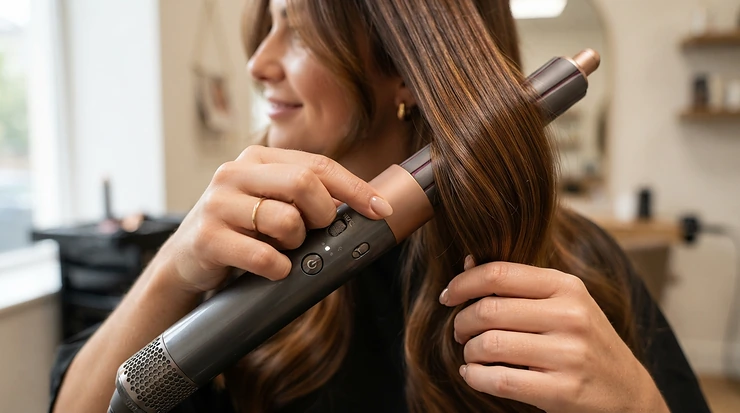
The standout is flexibility. The wand twists into an L-shaped dryer, so one tool replaces both.
It offers three heat levels (low, medium, high) plus a cool shot, and three airflow settings. It weighs about 700 g and draws about 1650 W. One reviewer-sourced listing puts the heat levels at roughly 95°C, 75°C and 55°C. The brand says it regulates air temperature continuously, so heat doesn’t climb the longer it runs. That’s a brand claim. Note that it’s not heatless, a point Shark’s own FAQ makes.
Here’s what to weigh: if you style with brushes or curlers, drying and styling happen at lower temperatures than a typical hot tool. Still, keep to the low or medium setting on freshly coloured hair. The Tom’s Guide review calls out three drawbacks. The case is bulky, the curling barrels are separate left and right units, and the noise level matches a typical dryer.
Pros:
- ✅ Replaces both dryer and styling tools
- ✅ Three heat levels plus cool shot
- ✅ Light at roughly 700 g
Cons:
- ❌ As loud as a typical hair dryer
- ❌ Bulky carry case and separate curling barrels
Price: roughly C$300-C$450. Verdict: strong value if you’d otherwise buy two tools, poor value if you only want a dryer.
4. BaBylissPRO Nano Titanium BNT9100 — nine heat-and-speed combinations
The standout is the digital 3-heat, 3-speed panel, which yields nine usable combinations.
It runs 1875 W with a true cold shot, ionic output, a roughly 2.7 m (9 ft) swivel cord and a limited four-year warranty. It weighs about 0.4 kg (0.88 lb) and ships with two concentrator nozzles. The practical advantage is decoupling heat from speed. You can pick low heat with high airflow, which dries faster than you’d expect without cooking the hair. That is the combination colour-treated hair wants.
One honest caution: titanium dryers can reach higher temperatures than ceramic ones, but they dry faster, so your hair spends less time exposed. That trade only works if you keep heat on low or medium. The brand’s own page shows a rating of just over four out of five. Some retailer listings for related Nano Titanium models list different heat counts, so confirm the BNT9100 model number says 3 heat.
Pros:
- ✅ Independent heat and speed control
- ✅ Long 2.7 m cord and four-year warranty
- ✅ True cold shot to set style
Cons:
- ❌ Titanium can run hot if you stay on high
- ❌ Exact temperatures aren’t published
Price: roughly C$150-C$230. Verdict: the best all-round value for most colour-treated heads.
5. Revlon One-Step Volumizer Plus 2.0 — four heat levels in a hot-air brush
The standout is volume. A paddle-style brush dries and shapes in one pass.
It’s a hot-air brush rather than a conventional dryer, with low, medium, high and cool-shot settings. The Plus version adds the medium setting, which makes it more versatile than the original. That medium step matters for dyed hair. Reviewers repeatedly warn that the original gets very hot, and one blogger with greying hair says she avoids the high setting. Sit on low or medium, and use the cool shot to finish.
My take is that this suits shoulder-length hair where volume matters more than raw speed. The brush design holds hair close to the heat source, so keep it moving and never park it on one section. Product buildup on bristles is the usual upkeep complaint with this style of tool, so clean them regularly.
Pros:
- ✅ Dries and shapes in a single pass
- ✅ Medium setting added in the Plus version
- ✅ Affordable entry into blowout-style results
Cons:
- ❌ High setting runs very hot per reviewers
- ❌ Less suited to very long or thick hair
Price: roughly C$50-C$90. Verdict: good value if you use low and medium only.

6. Remington Damage Protection D3190 — budget dryer with a true cool setting
The standout is the grille coating, a ceramic, ionic and tourmaline blend that the brand says gives “3x more protection” during styling. That claim is the brand’s own and comes with no independent test.
You get 1875 W, three heat settings, two speeds, a cool setting, and diffuser and concentrator attachments. A retailer’s review summary describes mixed feedback, with praise for powerful drying and light weight. One verified buyer says it “doesn’t get super hot” and dries their hair in about ten minutes. That’s anecdotal but fits the spec: a low setting that’s actually low.
The honest framing is that coatings don’t change physics. What helps your hair here is the combination of 1875 W airflow and a real low-heat position. Pair it with a concentrator and 15 cm of distance, and it handles daily drying for a fraction of the premium cost.
Pros:
- ✅ Real low setting plus cool option
- ✅ Diffuser and concentrator included
- ✅ Very low cost of entry
Cons:
- ❌ Protection claims are brand-only
- ❌ Two speeds only, less nuance than digital panels
Price: under C$50. Verdict: the budget pick to beat.
7. Conair Double Ceramic 565DCMC — everyday ceramic dependability
The standout is straightforward ceramic infrared heat at a price that barely registers.
You get 1875 W, three heat settings, two speeds, a cool shot, a removable filter, a concentrator and (per one Canadian retailer listing) a diffuser. The cord is 1.52 m (5 ft), noticeably short, so plan your outlet. Conair’s own safety guidance suggests lower settings for delicate and thin hair, which fits the colour-treated brief.
Retailer reviews of Conair dryers show a spread: one owner reports replacing a 20-year-old model, while another reports a failure after about four years. Durability varies by unit, as it does across this price band. If you want a no-surprises second dryer or a first dryer, this fits.
Pros:
- ✅ Three heat settings and cool shot at low cost
- ✅ Removable filter for easy cleaning
- ✅ Widely available through Canadian retailers
Cons:
- ❌ Short 1.52 m cord limits reach
- ❌ Durability reports are mixed
Price: roughly C$35-C$55. Verdict: strong value, with the cord as the main compromise.
How to Choose a Hair Dryer With Temperature Settings for Colour-Treated Hair
Follow these steps in order, and you’ll avoid the usual pitfalls.
- Count the heat settings. Three is the practical minimum. Two-position switches often force a choice between warm and scorching.
- Confirm there’s a true low. Look for published temperatures or reviewer notes that low really is gentle.
- Demand a cool shot. It closes the cuticle’s rough edges after styling and cuts total heat exposure.
- Prefer regulated heat if budget allows. Sensors on premium models stop temperature creeping up as the dryer runs.
- Check airflow, not just wattage. Strong airflow on low heat dries faster with less damage.
- Insist on a concentrator. It lets you aim air down the hair shaft rather than blasting it everywhere.
- Verify the safety plug and certification. See the Canadian safety section below.
This ordering matters. Most buyers start with attachments and colour, then discover three months later that the “low” setting still scorches. Start with heat behaviour, then work outward.
Cuticle Damage: What Heat Actually Does to Dyed Hair
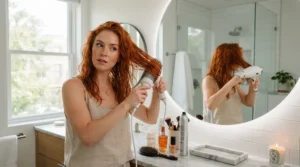
Cuticle damage is the first thing heat does to your hair. The cuticle is the outer shingle layer, and it acts as a thermal barrier for the protein-rich cortex underneath. Lift or crack those shingles, and dye molecules escape more easily while light bounces off a rougher surface (hello, dullness).
A frequently cited study in the Annals of Dermatology gives us numbers. In this peer-reviewed study of heat and drying time, hair tresses were treated 30 times. They were air-dried or blow-dried at 15 cm (about 47°C), 10 cm (about 61°C) or 5 cm (about 95°C). Blow-drying caused more surface damage than natural drying. Yet at 15 cm with continuous motion, it caused less overall damage than letting hair dry naturally. The cell membrane complex bulged only in the air-dried group. The researchers noted no cortex damage in any group.
The study used virgin hair, so dyed hair likely has less margin for error. Still, the lesson is clear. Distance is a temperature setting. Moving a dryer from 15 cm to 5 cm took the air at the hair from roughly 47°C to roughly 95°C. That is a bigger swing than any switch position on your dryer. Pair a low heat setting with 15 cm of distance, and you’ve addressed both variables.
Heat Control Hair Dryer for Dyed Hair: Settings, Sensors and Distance Explained
A heat control hair dryer for dyed hair does two jobs. It gives you low enough settings to use, and it keeps those settings steady. Sensors matter for the second job. Without them, element temperature can drift upward as the dryer runs. With them, the dryer self-corrects.
| Product | Published Heat Information | Best For |
|---|---|---|
| Dyson Supersonic r | 100°C / 80°C / 60°C / 28°C | Planning around known temperatures |
| Shark FlexStyle | About 95°C / 75°C / 55°C (reviewer-listed) | Styling at moderate heat |
| Dyson Supersonic Nural | 4 settings plus Scalp Protect Mode, sensor-regulated | Hands-off protection |
| BaBylissPRO Nano Titanium BNT9100 | 3 heat levels, temperatures unpublished | Mixing heat and speed |
| Remington Damage Protection D3190 | 3 heat levels, temperatures unpublished | Budget low-heat drying |
Where numbers are published, a pattern emerges. The gentlest drying setting sits around 55-60°C, the everyday setting around 75-80°C, and the “fast” setting at roughly 95-100°C. For colour-treated hair, start at the bottom rung and climb only when you need to. Where temperatures aren’t published, treat “low” as your default and verify by feel. If the air stings your wrist at 15 cm, it’s too hot for your hair.
Hair Dryer That Protects Hair Colour From Fading: What Actually Works
Let’s be direct. No hair dryer that protects hair colour from fading exists in the guaranteed sense. Fading has several drivers: washing frequency, UV exposure, the colour itself (reds fade faster than browns and blacks), cuticle damage and styling heat. A manufacturer’s research write-up on the topic states that more heat means more fade, and that damaged cuticles let dye escape more easily. That’s one company’s lab work, but it matches the basic mechanism.
So the useful question is this: which dryer habits and features reduce your fade rate? Three stand out.
- Lower, steadier heat. The sensor-regulated Dyson Supersonic Nural and the 60-80°C settings on the Dyson Supersonic r target this directly.
- Shorter heat exposure. Strong airflow on low heat, as on the BaBylissPRO Nano Titanium BNT9100, shortens the time your hair spends warm.
- A cool finish. Every model here has a cool shot or cool setting, and using it costs you ten seconds.
The rest is routine. Wash less often, rinse cooler, and shield hair from strong sun. Your dryer is one lever among several, but it’s the one you pull every morning.
Heat Protectant Compatibility: Matching Your Spray to Your Dryer
Heat protectant compatibility comes down to two questions. Does the product suit your dryer’s heat, and does it suit your routine? Protectants form a film on the hair that slows heat transfer and limits moisture loss. Many coat the cuticle with silicone. What they don’t do is make heat free. Water content matters too, so dry hair properly rather than trusting a spray to cover for a 100°C blast.
With conventional dryers like the Remington Damage Protection D3190 and Conair Double Ceramic 565DCMC, nearly any leave-in or spray protectant works. Apply it to towel-dried hair, comb through, then dry. Watch the intake side, though. Aerosol mist and heavy oils drift into filters, so tap and rinse the removable filter more often.
Heat protectant compatibility gets trickier with bristle-based tools. On the Revlon One-Step Volumizer Plus 2.0, product residue accumulates on the brush head and needs regular cleaning. On the Shark FlexStyle, the same applies to the brush attachments. Light, water-based sprays are the lower-maintenance match here.
One rule holds everywhere: protectant plus low heat plus distance beats any single measure alone.
Practical Usage Guide: Your First 30 Days
Week one: set up. Remove the filter and rinse any factory dust. Do a trial run on low heat and note how it feels at 15 cm. Mark your outlet position, since cord length (1.52 m on the Conair Double Ceramic 565DCMC, about 2.7 m on the BaBylissPRO Nano Titanium BNT9100) shapes how you move.
Technique, every time:
- Blot hair with a towel; don’t rub.
- Apply heat protectant to damp hair.
- Start on low heat, high airflow.
- Hold the dryer about 15 cm away and keep it moving.
- Point the nozzle down the hair shaft, root to tip.
- Finish with the cool shot.
Weeks two to four: tune it. Try stepping up one setting only if drying time drags. Watch for new frizz, which signals too much heat or too little distance. Clean the filter every two to four weeks.
Common first-month mistakes: parking the dryer in one spot, drying bone-dry on high, skipping the cool shot, and using the concentrator right against the scalp. Fix those four and you’ve solved most dryer damage before it starts.

Real-World Scenarios: Which Dryer Fits Which Life
The student on a tight budget. Fresh highlights, shared bathroom, drying four to five times a week. Choose the Remington Damage Protection D3190 or the Conair Double Ceramic 565DCMC. Keep to low heat, and spend the saved money on a decent protectant.
The busy professional with regular salon visits. Daily drying, a colour appointment every six to eight weeks, and a need for speed. The BaBylissPRO Nano Titanium BNT9100 pairs strong airflow with low heat, and its four-year warranty suits daily use.
The fine-haired buyer with a sensitive scalp. Thin, colour-treated hair that heats up quickly. Fine strands reach tool temperature faster because there’s less mass to warm. The Dyson Supersonic Nural is the logical fit.
The multi-tool minimalist. Wants one device for drying and curling. The Shark FlexStyle replaces two tools, and the Revlon One-Step Volumizer Plus 2.0 is the cheaper volume-focused alternative.
Match the tool to the routine, not the hype.
Hair Dryers vs Hot-Air Brushes vs Air-Drying: A Written Comparison
| Method | Heat Exposure | Best For |
|---|---|---|
| Conventional dryer (Remington Damage Protection D3190, BaBylissPRO Nano Titanium BNT9100) | Controlled by setting and distance | Most colour-treated hair |
| Hot-air brush (Revlon One-Step Volumizer Plus 2.0) | Closer contact, easy to overheat | Volume on mid-length hair |
| Multi-styler (Shark FlexStyle) | Moderate, regulated | Drying plus styling |
| Air-drying | None, but long water exposure | Short, fine hair in warm rooms |
The table hides a counterintuitive finding. In the Annals of Dermatology study, air-drying caused cell membrane complex damage that careful blow-drying didn’t. Long water exposure swells the fibre. So skipping the dryer isn’t automatically kinder. Dry quickly at low heat instead. Hot-air brushes concentrate heat on the section in contact, so they reward discipline. A conventional dryer with a concentrator is the most forgiving format for colour-treated hair, and a multi-styler like the Shark FlexStyle works if you stay on the lower settings.
Features That Actually Matter (And Those That Don’t)
What matters:
- A genuinely low heat setting.
- A cool shot or constant-cool option.
- A concentrator nozzle.
- A removable, easy-to-clean filter.
- Cord length that fits your bathroom.
What doesn’t (much):
- Peak wattage. Standard Canadian outlets top out near 1875 W on 15 A circuits. Past that, extra wattage is mostly marketing, as the basic mechanics of a hair dryer are simply a heater and a fan.
- Ionic and ceramic buzzwords. They may reduce static, but they don’t override temperature.
- Colour options. Lovely, irrelevant.
- Brand protection percentages. Claims like “3x more protection” are unverified without published test methods.
Notice what this does to the price ladder. The expensive models justify themselves through regulation and ergonomics, not raw power. If those don’t matter to you, the Conair Double Ceramic 565DCMC gives you the features that count.
Long-Term Cost and Maintenance
Cost per use reframes sticker shock. A dryer in the C$600-C$750 range, used four times a week for five years, works out to roughly 1,040 uses. That’s about 60 to 70 cents each. A C$40 model replaced every two years lands near 10 cents per use. The premium models therefore cost several times more per dry. What you’d be paying for is regulation, comfort and (possibly) a smaller colour-correction bill.
Maintenance is where cheap and expensive converge. Clean the filter every two to four weeks, wipe the grille, and never wrap the cord tightly around the body. Warranties vary. The BaBylissPRO Nano Titanium BNT9100 carries a limited four-year warranty, and Canadian Tire lists a two-year repair-only warranty on some Conair dryers. Keep your receipt.
Replacement attachments are another hidden cost. A lost diffuser on a budget model is cheap to replace. Premium attachment kits aren’t. If your hair is only mildly sensitive to heat, a good mid-range dryer plus a protectant plan often beats a flagship.
Safety, Certification and Canadian Regulations
Bathrooms and hair dryers share a long, unglamorous safety history. Many dryers include an Appliance Leakage Current Interrupter (ALCI) plug, which cuts power if water gets in. Conair’s own instruction booklet tells owners to check the ALCI feature each time they use the dryer. Older Canadian homes may also lack ground fault circuit interrupter (GFCI) outlets in the bathroom, which makes the plug’s protection more important.
Health Canada takes this seriously. A joint Health Canada recall of a hair dryer and diffuser involved a dryer marked as conforming to UL 859 but lacking an ALCI plug. That is a risk in homes without GFCI outlets if the product is immersed in water. The Canada Consumer Product Safety Act prohibits selling or even giving away recalled products.
Practical checklist: look for a recognized certification mark and an ALCI plug, search the Health Canada recalls database before you buy, never use the dryer near standing water, and don’t share a 15 A circuit with other high-draw appliances.

FAQ: Hair Dryers for Colour-Treated Hair
❓ What is the best hair dryer for dyed hair under C$100?
❓ Can I use a dryer with temperature settings on freshly bleached hair?
❓ Does a more expensive hair dryer really reduce colour fade?
❓ How often should I clean my hair dryer's filter?
❓ Are hair dryers bought on amazon.ca safe for Canadian bathrooms?
Conclusion
The best hair dryer with temperature settings for colour-treated hair isn’t the most powerful or the most expensive. It’s the one with a genuine low setting, a cool shot, and a design you’ll actually use properly. The Dyson Supersonic Nural and Dyson Supersonic r give you regulation and published temperatures at a premium. The Shark FlexStyle merges drying and styling. The BaBylissPRO Nano Titanium BNT9100 is the mid-range all-rounder. The Revlon One-Step Volumizer Plus 2.0 adds volume if you keep it on low or medium. The Remington Damage Protection D3190 and Conair Double Ceramic 565DCMC prove that budget doesn’t have to mean brutal.
Whichever you pick, the habits matter most: 15 cm of distance, constant motion, low heat first, a heat protectant, and a cool finish. Do that, and you’re protecting both your cuticle and your colour budget.
✨ Ready to give your colour the gentler dryer it deserves?
🛒 Click any highlighted product above to check current pricing and availability on amazon.ca, and treat your hair to a smarter routine today!
Recommended for You
- AC Motor Hair Dryer: 7 Ultimate Picks For Canada 2026
- High-Speed Hair Dryer: 7 Best Picks For Canada (2026)
- AC Motor Vs DC Motor Hair Dryer: 7 Best Picks In Canada (2026)
Disclaimer: This article contains affiliate links. As an Amazon Associate, I earn from qualifying purchases. If you purchase products through these links, we may earn a small commission at no additional cost to you.
✨ Found this helpful? Share it with your friends! 💬🤗
