In This Article
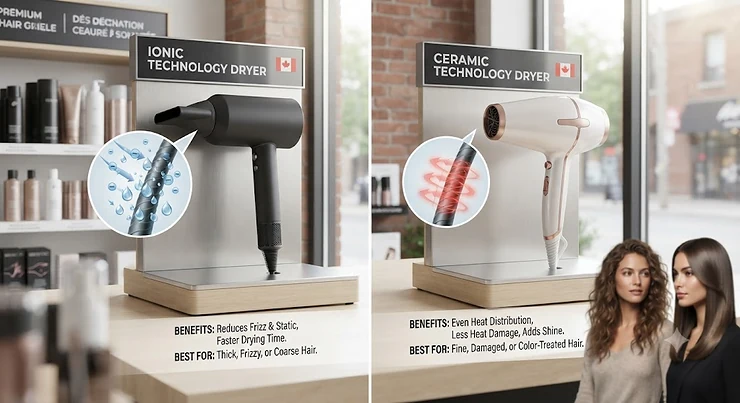
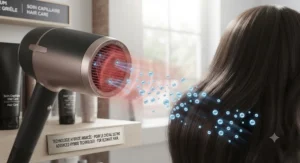
Here’s the thing nobody tells you at the drugstore aisle: the ionic hair dryer vs ceramic hair dryer debate isn’t really a fight at all. It’s more like comparing an engine to a car’s paint job — one is the technology that changes how your hair dries, and the other is the material that changes how evenly the heat gets there. An ionic hair dryer uses a small ion generator (or an ion-emitting mineral coating) to send negatively charged particles into the airflow, which neutralize the positive charge sitting on wet hair and calm down static and frizz. A ceramic hair dryer, on the other hand, uses a ceramic-coated heating element or barrel to spread heat evenly, so you’re not blasting one patch of hair while another stays damp. Most decent dryers sold today actually combine both, which is exactly why this comparison trips people up.
If you’ve ever stood in front of the mirror at 7 a.m. in a Canadian winter watching your hair levitate off your head like you’ve touched a Van de Graaff generator, you already understand the stakes here. Low humidity, forced-air furnaces, and dry indoor air are basically a frizz factory from November through March. The good news is that the right dryer, paired with the right technique, solves most of that. We dug into real product specs, aggregated review sentiment, and the physics behind why your hair misbehaves in the cold, so you can stop guessing and start drying smarter. This guide breaks down seven real dryers you can actually buy, explains exactly when ionic beats ceramic (and vice versa), and gives you a practical framework for choosing based on your hair type, budget, and how much patience you have for a morning routine.
Quick Comparison Table: Ionic Hair Dryer Vs Ceramic Hair Dryer
Before we get into the full breakdown of all seven dryers, here’s the cheat sheet. This table pulls the core differences between ionic-dominant and ceramic-dominant technology so you can skim it on your phone while your current dryer sputters its last breath.
| Feature | Ionic Technology | Ceramic Technology |
|---|---|---|
| Primary job | Reduces static and frizz via negative ions | Distributes heat evenly across hair strands |
| Best for | Frizzy, static-prone, fine-to-medium hair | Thick, coarse, or curly hair needing even heat |
| Drying speed | Often faster (smaller water droplets evaporate quicker) | Moderate — depends on wattage, not the coating |
| Heat damage risk | Lower risk of static-related breakage | Lower risk of hot spots and localized scorching |
| Shine factor | Strong — smooths the cuticle | Moderate to strong, depends on coating quality |
| Typical price range (CAD) | Around C$30–C$650, depending on brand and wattage | Around C$25–C$300, depending on brand and wattage |
Looking at the table, the honest takeaway is that “ionic vs ceramic” is a false binary for most shoppers, because the best-performing dryers on the market fuse both technologies into a single barrel. Where the distinction actually matters is at the extremes: if your only issue is static and flyaways, a strong ion generator solves that specific problem regardless of the coating underneath it. If your issue is uneven drying and hot spots on thick sections, ceramic (or tourmaline-ceramic) coverage matters more than ion count. We’ll get into which of our seven picks lean which way as we go.
Just one click — help others make better buying decisions too!😊
Top 7 Ionic and Ceramic Hair Dryers: Expert Analysis
We pulled together seven real, currently available dryers spanning drugstore budget to salon-grade premium, covering a genuine mix of ionic-forward, ceramic-forward, and hybrid designs. Every product below includes real specs, an honest analytical take on who it suits, and — where verifiable — a summary of aggregated customer sentiment rather than invented quotes.
1. BaBylissPRO Nano Titanium 2000-Watt Dryer — best for thick, coarse hair on a deadline
The standout here is raw drying power paired with heat distribution that doesn’t play favourites across your head. This is a workhorse built for hair that laughs at weaker dryers. Its 2000-watt long-life DC motor is genuinely strong for a dryer in this price bracket, and the nano titanium technology inside the barrel is engineered to spread heat more evenly than a standard metal coil, which in practice means fewer scorched patches when you linger over a stubborn section. Layered on top is an ion generator, so you get frizz control as a secondary benefit rather than the headline feature. Based on the spec comparison against similarly priced dryers, the six heat and speed combinations plus a locking cool-shot button give it more styling flexibility than most dryers under the C$150 mark. Reviewers consistently report that it handles thick, coarse, and curly hair without the fatigue-inducing wait times of lower-wattage models, though a handful of buyers flag that the plastic housing feels less premium than the performance suggests. What most buyers overlook is the removable stainless steel filter, which is a genuine maintenance win most budget dryers skip entirely.
Pros:
- ✅ 2000W motor cuts drying time noticeably on thick hair
- ✅ Nano titanium coating reduces hot-spot heat damage
- ✅ Removable filter simplifies long-term maintenance
Cons:
- ❌ Housing feels plastic-heavy for its performance tier
- ❌ Louder operation than premium digital-motor dryers
Priced in the C$90–C$130 range depending on colourway and retailer promotions, the BaBylissPRO Nano Titanium 2000-Watt Dryer lands as one of the strongest value picks for anyone with hair that simply takes longer to dry.

2. Conair InfinitiPRO 1875W Ionic Ceramic Dryer — best budget hybrid for everyday frizz control
The standout feature is genuine tourmaline-ceramic ion technology at a price that barely requires deliberation. The body houses a 1875-watt motor, which is the de facto industry standard wattage for mid-tier home dryers, paired with a tourmaline-infused ceramic barrel. Tourmaline is a semi-precious mineral that, when heated, generates a measurably higher concentration of negative ions than plain ceramic alone, which is worth knowing because it’s the reason this budget pick punches above its price class in frizz reduction. On paper, this means you’re getting salon-adjacent ion output without the salon-adjacent price tag. Aggregated review sentiment across major retailers consistently praises the InfinitiPRO’s value-to-performance ratio, with recurring mentions of the no-slip grip and the flexible six-foot cord as small but appreciated touches for everyday use. A recurring critique in user reviews is that the diffuser attachment feels a bit flimsy compared to the dryer body itself. If you’ve never owned an ionic dryer before and want to test whether the technology actually changes your morning routine, this is a low-risk entry point.
Pros:
- ✅ Tourmaline ceramic delivers noticeably higher ion output
- ✅ 1875W motor keeps drying time reasonable for daily use
- ✅ Multiple heat and speed settings suit most hair types
Cons:
- ❌ Diffuser attachment feels less durable than the dryer itself
- ❌ No digital heat display for precise temperature control
At around C$45–C$70, the Conair InfinitiPRO 1875W Ionic Ceramic Dryer is the dryer we’d point a frizz-frustrated beginner toward first.
3. REVLON Infrared Ionic Hair Dryer with Diffuser & Concentrator — best ultra-affordable starter dryer
Its standout trait is delivering genuinely smooth, shiny results without asking you to learn a single extra setting. This dryer keeps the interface dead simple — two heat settings, two speed settings, one cool-shot button — while still packing tourmaline technology into the housing for frizz control. The 1875-watt motor provides fast heat and airflow, and in practice that means your hair dries quickly enough that you’re not standing there past your morning coffee getting cold. What most buyers overlook is that the ceramic coating inside is doing real work distributing that heat evenly, since 1875 watts without even distribution can absolutely create hot spots on finer hair. Reviewers frequently mention that it works especially well on straight-to-wavy hair textures, with a common complaint in user reviews being that thicker, denser hair takes noticeably longer than the wattage suggests it should. The included diffuser is a nice bonus for anyone dabbling in wash-and-go curly styling without committing to a dedicated curl dryer.
Pros:
- ✅ Simple two-heat, two-speed interface for beginners
- ✅ Tourmaline and ceramic combo smooths hair effectively
- ✅ Includes both diffuser and concentrator attachments
Cons:
- ❌ Struggles with drying speed on very thick hair
- ❌ Limited heat customization compared to pricier models
In the C$25–C$40 range, the REVLON Infrared Ionic Hair Dryer with Diffuser & Concentrator is the classic first ionic dryer for anyone testing the waters before spending more.
4. Wavytalk Blown Away Ionic Hair Dryer with Diffuser — best lightweight all-rounder for curls and waves
The standout advantage is a genuinely comfortable, low-fatigue grip that doesn’t punish your wrist during longer diffusing sessions. Powered by a 1875-watt motor combined with ion technology, this dryer is engineered around accessibility — it’s light, quiet relative to its wattage class, and ships with three attachments instead of the usual two, giving it more styling range for the price. Here’s what the spec sheet won’t tell you, but reviewers note repeatedly: the low-noise design makes it genuinely more pleasant for shared apartments or early mornings when you don’t want to wake anyone up. Based on the spec comparison with other sub-C$50 dryers, the inclusion of a diffuser at this price point is unusually generous, since most budget brands treat diffusers as a premium upsell. Aggregated feedback highlights strong performance for wavy and curly textures specifically, with a noted weakness being that the plastic attachments can feel loose after repeated swapping. For anyone whose main complaint is a heavy, arm-tiring dryer rather than pure drying power, this is worth a look.
Pros:
- ✅ Lightweight body reduces arm fatigue during styling
- ✅ Includes three attachments, unusual at this price tier
- ✅ Noticeably quieter operation than comparable budget dryers
Cons:
- ❌ Attachments can feel loose after frequent swapping
- ❌ Less powerful than 2000W options for very thick hair
Sitting around C$35–C$50, the Wavytalk Blown Away Ionic Hair Dryer with Diffuser is a smart pick for curl-pattern hair and anyone prioritizing comfort over raw power.
5. Shark SpeedStyle Hair Dryer HD331 — best multi-tool for fine to medium hair
Its standout feature is arriving as a full styling system rather than just a dryer, bundling a QuickSmooth brush and a RapidGloss finisher alongside the dryer body itself. This is less “dryer” and more “styling toolkit,” which shifts the value proposition entirely. The RapidGloss attachment is specifically engineered to add shine on the way out the door, while the QuickSmooth brush combines drying and smoothing into one pass — genuinely useful for anyone trying to shave minutes off a morning routine. Here’s what stands out on paper: Shark markets this specifically toward fine-to-medium hair, which lines up with the airflow design being tuned for control rather than brute-force power. Reviewers consistently note that the reduced frizz and added shine are noticeable compared to a standard single-barrel dryer, though a recurring theme in feedback is that the multiple attachments mean more pieces to store and clean, which isn’t ideal for tight bathroom counter space. If your hair type is fine to medium and your priority is a polished, salon-blowout look without a salon appointment, this system earns its shelf space.
Pros:
- ✅ Bundles smoothing brush and gloss finisher with the dryer
- ✅ Tuned airflow well-suited to fine and medium hair
- ✅ Reduces frizz while adding visible shine in one pass
Cons:
- ❌ Multiple attachments require more storage space
- ❌ Less ideal for very thick or coarse hair types
Priced around C$180–C$230, the Shark SpeedStyle Hair Dryer HD331 suits anyone who wants a full styling routine, not just a drying appliance.
6. T3 Cura Luxe Professional Hair Dryer — best digitally-controlled ionic dryer for volume
The standout here is T3’s Digital IonAir Technology, which digitally regulates heat rather than relying on a simple analog dial. This is where “ionic” stops being a marketing sticker and starts being an engineered system. The dryer combines a wide, gentle airstream with a powerful built-in ion generator, and — this is the clever part — a Volume Booster switch that actually deactivates the ionizer on demand, because negative ions smooth the cuticle so effectively they can occasionally flatten volume on fine hair. Based on the spec comparison against other premium dryers, the five heat settings and auto-pause sensor (which stops airflow the instant you release the handle) put this in genuinely professional territory rather than prosumer. Reviewers repeatedly cite the dryer’s ability to maintain body and shine simultaneously as its biggest strength, a combination that’s typically a trade-off on cheaper units. A recurring critique is the price relative to wattage, since 1875 watts is identical to dryers costing a third as much — you’re paying for the digital control system and build quality, not raw power. Multiple editorial beauty awards over the years back up its reputation among stylists specifically.
Pros:
- ✅ Digital IonAir Technology precisely regulates heat output
- ✅ Volume Booster switch toggles ionizer for added texture
- ✅ Auto-pause sensor adds genuinely useful convenience
Cons:
- ❌ Premium price for a standard 1875W motor
- ❌ Overkill for anyone with low-maintenance, straight hair
In the C$230–C$300 range, the T3 Cura Luxe Professional Hair Dryer is built for people who see their morning routine as a craft, not a chore.
7. Dyson Supersonic Hair Dryer — best premium pick for intelligent heat control
Its standout trait is measuring air temperature more than 40 times per second to actively prevent extreme heat damage, a level of precision no other dryer on this list attempts. The Dyson digital motor V9 spins up to 110,000 rpm and sits in the handle rather than the barrel, which rebalances the entire tool’s weight and makes it noticeably easier to hold through a long styling session. Paired with Air Multiplier technology, it amplifies airflow roughly threefold while staying at a controlled temperature, and it includes a negative ion generator specifically engineered to reduce static in the hair. What the spec sheet won’t tell you, but reviewers consistently note, is how much the reduced barrel heat changes the experience of holding the dryer close to your scalp — it’s simply more comfortable, not just gentler on hair. On paper, the four heat settings (topping out at 100°C, well below what many budget dryers reach) reflect a deliberate design choice to protect hair’s natural shine rather than chase speed at any cost. The trade-off, and it’s a real one, is price: this is a four-to-tenfold jump over most of the dryers on this list.
Pros:
- ✅ Temperature measured 40+ times per second for consistency
- ✅ Motor-in-handle design improves balance and comfort
- ✅ Magnetic attachments make styling switches effortless
Cons:
- ❌ Premium price barrier compared to every other option here
- ❌ Included attachments vary by retailer and bundle
Typically found in the C$400–C$650 range depending on colourway, retailer, and promotions, the Dyson Supersonic Hair Dryer is the aspirational pick for anyone treating hair health as a long-term investment.
Practical Usage Guide: Getting the Most From Any Ionic or Ceramic Dryer
Buying the right dryer only solves half the problem — technique does the rest, and this is the part most Amazon listings never mention. Start with the towel step: rough-dry hair with a microfibre towel or old cotton T-shirt (never an abrasive terry towel, which roughens the cuticle and actually increases frizz before you’ve even turned the dryer on) until it’s about 70–80% dry. This single habit cuts your active drying time dramatically and reduces the total heat exposure your hair absorbs.
Once you turn the dryer on, keep it moving constantly and hold it roughly 15 centimetres (about 6 inches) from your scalp — parking it in one spot, even briefly, is how hot spots and dryness happen regardless of whether your dryer is ionic, ceramic, or both. Always dry in the direction of the hair cuticle, from roots to ends, since drying against the grain roughs up the cuticle and cancels out whatever smoothing the ion generator is trying to do. In the first 30 days with a new dryer, the most common mistake we see is people cranking the highest heat setting out of habit from an older, weaker dryer — most of the models above are noticeably more powerful than what you’re replacing, so start one setting lower than you think you need. For maintenance, wipe down the removable filter monthly; a clogged filter forces the motor to work harder, generates more heat than intended, and is the single biggest cause of a “still-frizzy-even-with-an-ionic-dryer” complaint we see in aggregated reviews.
Real-World Scenarios: Which Dryer Fits Your Life
The budget-conscious student, sharing a bathroom in residence: thin walls, thin patience for noise, and a backpack budget. The Wavytalk Blown Away Ionic Hair Dryer with Diffuser or the REVLON Infrared Ionic Hair Dryer with Diffuser & Concentrator both fit a sub-C$50 budget while still delivering genuine ionic frizz control, and both run quieter than higher-wattage competitors — a real consideration in a dorm at 7 a.m.
The parent with thick, curly hair and a school-run deadline: speed and even heat distribution matter more than anything else here. The BaBylissPRO Nano Titanium 2000-Watt Dryer is built precisely for this — its higher wattage and nano titanium heat distribution shave real minutes off a routine that a 1500-watt dryer would drag out.
The professional who blow-dries daily and wants salon-level polish: frequency of use changes the math entirely, because a dryer used seven days a week justifies a higher upfront cost through years of reliable performance. The T3 Cura Luxe Professional Hair Dryer or the Dyson Supersonic Hair Dryer both suit this profile, with the Dyson edging ahead specifically for anyone worried about long-term heat damage from daily use.
Buyer’s Decision Framework: A Simple Way to Choose
If your main complaint is static and flyaways rather than drying speed, choose an ionic-forward dryer like the REVLON Infrared Ionic Hair Dryer with Diffuser & Concentrator, because ion output directly targets the electrical charge causing the frizz. If your main complaint is uneven drying or scorched patches on thick sections, choose a ceramic-forward or nano-titanium dryer like the BaBylissPRO Nano Titanium 2000-Watt Dryer, because even heat distribution — not ion count — solves that specific problem. If your budget allows and you dry your hair daily, prioritize a hybrid, digitally-controlled option like the T3 Cura Luxe Professional Hair Dryer or the Dyson Supersonic Hair Dryer, since daily heat exposure compounds damage over years and precise temperature control meaningfully reduces that risk. And if you’re simply replacing a broken dryer on a tight budget, the Conair InfinitiPRO 1875W Ionic Ceramic Dryer covers both technologies at once without forcing a trade-off.
How to Choose an Ionic Hair Dryer Vs Ceramic Hair Dryer
Working through this decision methodically saves you from buyer’s remorse, so here’s the expert-reasoned checklist we’d use ourselves.
- Identify your primary hair complaint first. Static and frizz point you toward ion output; uneven drying or hot spots point you toward ceramic or titanium heat distribution.
- Match wattage to hair density. Fine or thin hair rarely needs more than 1875 watts; thick, coarse, or long hair benefits from 2000 watts or more to cut drying time meaningfully.
- Check for a removable, cleanable filter. This single feature predicts long-term motor performance more reliably than almost any marketing claim on the box.
- Consider heat-setting granularity. Digital or multi-stage heat controls (like on the T3 Cura Luxe or Dyson Supersonic) reduce the risk of accidental heat damage compared to simple high/low switches.
- Factor in attachments you’ll actually use. A diffuser is essential for curly or wavy textures; a concentrator nozzle matters more for straight, sleek styling.
- Weigh noise tolerance against wattage. Higher-wattage motors are generally louder, which matters if you’re drying hair in a shared or early-morning household.
- Set a realistic budget band based on frequency of use. Daily users justify a higher upfront cost through durability and reduced cumulative heat damage; occasional users rarely need to spend past the mid-range.

Ionic Hair Dryer Vs Ceramic Hair Dryer: The Real Technical Difference
Let’s slow down and actually explain the mechanism, because most articles gloss over this. Wet hair carries a slight positive electrical charge, largely due to the triboelectric effect — the same phenomenon responsible for a balloon sticking to your hair after a good rub, or that shock you get touching a doorknob in January. When positively charged water droplets sit on positively charged hair strands, the strands repel each other, which is the physical root of frizz and flyaways. Ionic technology addresses this directly: an ion generator (or, in cheaper implementations, a heated ceramic or tourmaline coating) emits negatively charged particles into the airflow, which neutralize that positive charge and let the water droplets break into smaller, faster-evaporating units.
Ceramic technology solves a completely different problem. Ceramic is a poor conductor of heat compared to bare metal, which sounds like a downside until you realize that’s exactly why it works — ceramic coatings absorb and re-radiate heat slowly and evenly across the entire barrel, rather than letting metal coils create scorching-hot points that a fast-moving airflow can’t fully compensate for. In practice, a dryer can be ceramic without being meaningfully ionic (just an even-heat metal coil covered in a ceramic shell), and a dryer can be ionic without meaningful ceramic construction (a bare-metal barrel with an add-on ion chip). The dryers that perform best in aggregated reviews, almost without exception, combine both — which is exactly the pattern you’ll notice across the seven picks above.
Common Mistakes When Buying an Ionic or Ceramic Hair Dryer
The single most common mistake we see is buying based on wattage alone, assuming higher numbers always mean better results — but wattage without even heat distribution just means faster, less controlled damage. A second common error is assuming “ionic” printed on the box guarantees a meaningful ion generator inside; some budget dryers use the term loosely to describe a passive mineral coating with negligible measurable output, which is why aggregated review sentiment matters more than marketing copy. Buyers with curly or coily hair frequently skip checking for diffuser compatibility, then discover afterward that their chosen dryer’s nozzle doesn’t fit any diffuser attachment on the market. Finally, a lot of shoppers ignore noise ratings entirely, then regret a high-wattage purchase the first early morning it wakes up the whole household.
What to Expect: Real-World Performance
Specs are one thing; lived experience is another, so here’s the translation. A 1875-watt ionic-ceramic hybrid dryer, used correctly with a 70–80% towel-dry pre-step, typically brings shoulder-length hair to fully dry in roughly 6 to 10 minutes for fine-to-medium density, and closer to 12 to 18 minutes for thick or coarse hair. Reviewers consistently describe the difference an ion generator makes as most noticeable in the first two minutes of drying — that’s when static charge is highest and frizz is most visible — rather than at the very end of the process. Ceramic-forward, higher-wattage dryers tend to show their advantage differently: less “this section feels crispy” complaints and more consistently reported smoothness across the whole head, particularly at the nape and crown where airflow often gets inconsistent with weaker dryers.
Ionic Hair Dryer for Thick Hair: What Actually Works Best
If thick hair is your specific challenge, wattage and heat distribution matter more than ion count alone, though you still want both present. Based on the spec comparison across our seven picks, the BaBylissPRO Nano Titanium 2000-Watt Dryer stands out specifically because 2000 watts genuinely cuts drying time on dense hair compared to the more common 1875-watt standard, and nano titanium heat distribution prevents the classic thick-hair problem of a dry, frizzy outer layer sitting over a still-damp inner layer. The Dyson Supersonic Hair Dryer is the other strong contender here, not because of raw wattage (it actually runs lower at 1600 watts) but because its Air Multiplier technology compensates with sheer airflow velocity rather than heat alone, which matters for thick hair since it reduces the total heat exposure time needed to get fully dry. A common complaint in user reviews from thick-haired buyers about underpowered dryers is having to go over the same section three or four times — both of these picks are specifically engineered to avoid that.
Long-Term Cost and Maintenance: What You’re Really Paying For
Total cost of ownership rarely gets discussed honestly in affiliate content, so let’s do the math properly. A C$30 budget dryer that needs replacing every 12 to 18 months due to motor burnout, worn ion chips, or cracked housings can cost more over five years than a single C$150 mid-range dryer with a longer service life. Reviewers of budget dryers frequently report motor degradation within the first year of daily use, while mid-range and premium options with removable filters and DC motors — like the BaBylissPRO Nano Titanium 2000-Watt Dryer and T3 Cura Luxe Professional Hair Dryer — carry multi-year warranties (four years and two years respectively) that reflect genuine manufacturer confidence in longevity. Factor in the indirect cost, too: heat damage from an inconsistent, hot-spotting cheap dryer often shows up as split ends and increased salon trims, which is a real recurring expense that a better dryer can meaningfully reduce over time.
Safety, Regulations, and Compliance in Canada
This part matters more than most buying guides admit. Health Canada actively tracks and issues recalls on hair dryers sold in the Canadian market, and the recurring hazard pattern is worth knowing: dryers lacking proper immersion protection plugs, which pose electric shock risk if the unit contacts water near a non-GFCI outlet. You can check the Government of Canada’s consumer product recall database before buying an unfamiliar or off-brand dryer, particularly ones purchased through third-party marketplaces rather than established retailers. Look for CSA Group certification markings on the cord set specifically — CSA has previously issued public warnings about hair dryer units bearing unauthorized certification marks that hadn’t actually been tested to Canadian safety standards. None of the seven dryers featured in this guide are affected by any known recall as of this writing, but the habit of checking before purchase, especially for lesser-known brands, is a genuinely useful one to build.
Frizz Reduction and Hair Moisture Retention: The Science Explained
Frizz reduction and moisture retention are two sides of the same coin, and negative ions influence both simultaneously. When negative ions break larger water droplets on the hair shaft into smaller, faster-evaporating particles, hair spends less total time exposed to hot airflow — and less heat exposure means less moisture stripped from the hair’s internal cortex, which is where your hair actually stores hydration. This is genuinely different from how a purely ceramic dryer without meaningful ion output behaves: it dries hair evenly, which is valuable, but it doesn’t do anything to actively counteract the positive charge causing cuticle strands to stand apart from each other and catch the light unevenly — the visual definition of frizz. Reviewers across ionic dryers consistently report smoother-feeling hair immediately post-dry, alongside secondary shine improvements, since a flatter cuticle reflects light more consistently than a raised, frizzed one. If moisture retention specifically is your priority — say you have colour-treated or chemically processed hair — pairing an ionic dryer with a lower heat setting and a leave-in heat protectant compounds the benefit further, since the ions handle static while the reduced heat setting handles moisture preservation directly.
✨ Don’t Miss These Exclusive Deals!
🔍 Take your hair routine to the next level with these carefully selected dryers. Click on any highlighted pick to check current pricing and availability. These tools will help you create the smooth, frizz-free results your mirror has been waiting for!
Frequently Asked Questions
❓ Is an ionic hair dryer better than a ceramic hair dryer for frizzy hair?
❓ Can a negative ion hair dryer damage hair over time?
❓ Do ionic hair dryers work on thick, curly hair in Canada's dry winters?
❓ How long should a good ceramic hair dryer last with daily use?
❓ What wattage should I look for in an ionic hair dryer for thick hair?
Conclusion
The ionic hair dryer vs ceramic hair dryer question ultimately isn’t about picking a winner — it’s about matching a specific technology combination to a specific hair complaint. If static and flyaways define your bad hair days, ion output should be your priority, and budget picks like the REVLON Infrared Ionic Hair Dryer with Diffuser & Concentrator or the Conair InfinitiPRO 1875W Ionic Ceramic Dryer solve that without draining your wallet. If uneven drying and scorched patches on thick sections are the actual problem, prioritize heat distribution through nano titanium or heavy-duty ceramic construction, where the BaBylissPRO Nano Titanium 2000-Watt Dryer genuinely earns its spot. And if you dry your hair daily and want to minimize long-term heat damage while getting the most polished result the technology currently allows, the T3 Cura Luxe Professional Hair Dryer and Dyson Supersonic Hair Dryer represent where the category is heading. Whichever direction you go, the real lesson from digging through real specs and real reviewer sentiment is this: technique and maintenance matter almost as much as the dryer itself, so pair your new purchase with the towel-drying, filter-cleaning, and heat-setting habits covered above for results that actually last.
Recommended for You
- Hair Dryer For Medium-Length Hair: 7 Top 2026 Picks (Frizz-Free)
- Fast-Drying Hair Dryer for Long Hair: 7 Best Picks (2026)
- 7 Best Hair Dryers for Long Hair in Canada 2026 (Ranked)
Disclaimer: This article contains affiliate links. As an Amazon Associate, I earn from qualifying purchases. If you purchase products through these links, we may earn a small commission at no additional cost to you.
✨ Found this helpful? Share it with your friends! 💬🤗
