In This Article
Here’s a scene most of us know a little too well: you spend fifteen minutes on your roots, walk out the door feeling like you’ve got body for days, and by 10 a.m. your hair has quietly staged a retreat back to your scalp. Flat on top, a bit shiny at the part line, and somehow already asking for a wash. If that’s your Tuesday-through-Friday reality, the problem usually isn’t your hair — it’s your tool. A root-lifting hair dryer is built specifically to lift hair away from the scalp while it dries, using barrel shape, nozzle angle, and airflow direction to fight gravity and oil at the same time, instead of just blasting hot air and hoping for the best.
This guide breaks down seven real, currently available root-lifting hair dryer options for the Canadian market, from budget-friendly traditional dryers to hybrid brush-dryers to a genuine splurge pick. We’ll get into which one actually works for oily, fine hair that goes limp by lunchtime, which nozzle attachments are worth the extra plastic in the box, and where a C$12 tub of volumizing mousse might do more work than a C$300 gadget. According to the Canadian Dermatology Association, oily hair simply reflects an oily scalp, since hair follicles sit next to oil-producing glands that generate sebum naturally — which is exactly why the wrong dryer technique can make root volume disappear almost as fast as you create it.
What Is a Root-Lifting Hair Dryer?
A root-lifting hair dryer is a blow dryer — sometimes a traditional handheld unit, sometimes a hot-air styling brush — engineered with a narrow nozzle, oval barrel, or round-brush attachment that concentrates airflow directly at the scalp. The goal is to dry hair upward and away from the head rather than flat against it, which builds lasting volume at the root instead of just drying hair in whatever position gravity left it.
Quick Comparison Table
| Product | Type | Best For | Price Range (CAD) |
|---|---|---|---|
| Revlon One-Step Volumizer PLUS | Hot-air styling brush | All-around blowout volume | C$70-C$90 |
| Revlon One-Step Root Booster | Compact round-brush dryer | Oily roots, fine flat hair | Under C$70 |
| Conair InfinitiPRO Volume & Shine Pro | Traditional AC dryer | Budget volumizing under C$70 | Under C$70 |
| BaBylissPRO Nano Titanium 2000W | Traditional AC dryer | Thick or coarse roots | C$90-C$130 |
| Shark HyperAIR Rotating Brush | Auto-sensing hot-air brush | Hands-free root lift | C$180-C$230 |
| T3 Featherweight StyleMax Professional | Lightweight ionic dryer | Daily styling, less arm fatigue | C$200-C$260 |
| Dyson Supersonic | Premium intelligent dryer | Sensitive scalps, fine hair | C$500-C$600 |
Looking at the spread above, the story isn’t really “cheap versus expensive” — it’s “brush versus barrel.” The Revlon One-Step Root Booster and Conair InfinitiPRO Volume & Shine Pro both live comfortably under C$70 and target the exact oily-roots, flat-hair problem this article opened with, while the Dyson Supersonic and T3 Featherweight StyleMax Professional are paying for lighter handling and gentler, more controlled heat rather than for stronger root lift itself. The two Revlon hybrids sit in the middle because they replace a separate round brush entirely, which is worth factoring into any price comparison.
💬 Just one click — help others make better buying decisions too!😊
💬 Found a favourite already? A quick share helps other Canadians dodge the flat-hair guessing game too!
Top 7 Root-Lifting Hair Dryers: Expert Analysis
1. Revlon One-Step Volumizer PLUS — best all-round blowout in a single step
The standout feature here is right in the name: this is a dryer and a round brush fused into one tool, so there’s no switching implements mid-blowout. The oval brush barrel — reported at roughly 2.4 inches — combines tourmaline ionic technology with charcoal-infused nylon bristles and tufted boar bristles, which in practice means the brush grips and lifts sections at the root while the ionic function is working to flatten the cuticle and cut frizz at the same time. Four heat and speed settings (low, medium, high, and a cool shot) give you enough range to go gentle on fine, colour-treated hair or crank it up for thicker sections.
Based on the spec comparison with plain round brushes, the appeal is time: you’re not drying first and then brushing separately, so a full blowout routine typically shrinks by several minutes. This is genuinely built for anyone with short-to-mid-length straight or wavy hair who wants a salon-adjacent finish without salon-adjacent time. Roundups covering this model report it has racked up hundreds of thousands of verified reviews in the North American market, making it one of the most reviewed volumizing tools in its category — reviewers consistently flag the detachable brush head and the noticeably reduced frizz as the biggest wins, while a recurring complaint is that very thick or tightly coiled hair sometimes needs two or three passes to fully dry.
Pros:
- ✅ Combines drying and round-brushing in one pass
- ✅ Detachable head makes cleaning and storage easier
- ✅ Four heat/speed settings suit fine to medium hair
Cons:
- ❌ Thick or coily hair often needs multiple passes
- ❌ Heavier in the hand than a standalone dryer
At around C$70-C$90, this sits in the middle of our lineup, and for anyone who currently owns a separate round brush and dryer, replacing both with one device is where the real value shows up.
2. Revlon One-Step Root Booster — best compact pick for oily roots and flat fine hair
This is the sibling model built specifically for the problem in this article’s title: oily roots that go limp fast. The standout feature is its smaller 1.5-inch round brush barrel, which is deliberately scaled down from the Volumizer PLUS to fit closer to the scalp and work through shorter sections — exactly the technique that lifts roots without dragging length-heavy air through hair that’s already thin. Ionic technology and three heat/speed settings round out the spec sheet.
What most buyers overlook about the smaller barrel size is that it’s not a downgrade — it’s the actual mechanism that makes root lift possible on fine hair, since a bigger barrel can’t get close enough to the scalp on finer strands without pulling too hard. This is the pick for anyone whose hair type skews chin-length to medium and whose main complaint is oil-driven flatness rather than frizz or curl. Aggregated review sentiment for this style of compact root-lift brush tends to note that it excels at exactly one job — root volume — while offering less versatility for full-length styling than the larger Volumizer PLUS.
Pros:
- ✅ Smaller barrel reaches close to oily, fine roots
- ✅ Ionic technology reduces frizz while lifting
- ✅ Lightweight enough for quick morning touch-ups
Cons:
- ❌ Barrel size limits use for longer lengths
- ❌ Fewer heat settings than the Volumizer PLUS
Priced under C$70, this is the single best match on this list for the “hair dryer for oily roots flat hair” problem specifically, since it was engineered around that exact use case rather than general-purpose blowouts.
3. Conair InfinitiPRO Volume & Shine Pro — top hair dryer for volumizing oily fine hair under $70 CAD
If you’d rather keep a traditional handheld dryer and add your own concentrator or diffuser, this is the standout budget option, and its whole design brief is volume. The salon-style AC motor is rated to dry roughly 50% faster than comparable DC-motor dryers and is built to last significantly longer under daily use, while ionic technology is engineered to cut frizz meaningfully compared to non-ionic budget models. It ships with both a concentrator for precision root work and a diffuser for curl definition, plus a true cold-shot button to lock the lift in place once you’ve finished.
Here’s what the spec sheet won’t tell you outright: an AC motor in a sub-C$70 dryer is unusual, since most budget dryers use cheaper, shorter-lived DC motors, so this model punches above its price bracket on raw durability. Reviewers consistently note that the concentrator attachment, when angled upward at the root while lifting sections with a brush, produces noticeably more lasting lift than using the bare nozzle. The trade-off is that, unlike the Revlon hybrids, you still need your own round brush for a true blowout shape.
Pros:
- ✅ AC motor outlasts typical budget DC dryers
- ✅ Includes both concentrator and diffuser
- ✅ True cold-shot button locks in root volume
Cons:
- ❌ Requires a separate round brush for full styling
- ❌ Louder than premium AC motor dryers
Sitting under C$70, this is the model we’d point to if the phrase “volumizing oily fine hair” describes your hair type and you want to keep costs down without settling for a weak, unbranded motor.
4. BaBylissPRO Nano Titanium 2000W — best power-to-price for thick or coarse roots
The standout advantage on this one is raw power paired with a professional finish: a 2000-watt motor, six total heat and speed combinations, and nano-titanium ionic technology that’s engineered for gentle, even heat distribution rather than concentrated hot spots. A removable rear filter keeps lint from choking the motor over time, and the brand backs it with a notably long four-year limited warranty for a device in this price bracket.
Based on the spec comparison with the budget dryers above, 2000 watts is a meaningful jump from the roughly 1875-watt units common at lower price points, and in practice that extra power matters most on thick, coarse, or long hair where a weaker motor simply runs out of steam before the roots are fully dry and lifted. What most buyers overlook is that “professional grade” here isn’t just marketing — nano-titanium coatings are genuinely better than plain ceramic at spreading heat evenly across the barrel, which reduces the scorched, frizzy look that comes from uneven hot spots. Reviewers in the professional and semi-professional space consistently cite the drying speed and the far-infrared heat penetration as the standout traits, with the main knock being that it’s heavier than ultra-light travel dryers.
Pros:
- ✅ 2000W motor handles thick or coarse hair fast
- ✅ Nano-titanium tech spreads heat evenly
- ✅ Four-year warranty is long for this category
Cons:
- ❌ Heavier than lightweight travel dryers
- ❌ No brush attachment included for root shaping
In the C$90-C$130 range, this is the pick for anyone whose current dryer simply isn’t strong enough to lift and dry heavier hair before the roots settle back down flat.
5. Shark HyperAIR Rotating Brush — best auto-sensing heat for hands-free root lift
The headline feature is Shark’s HyperAIR IQ technology, which uses dual optical sensors to automatically read hair thickness and moisture level, then adjusts heat and airflow in real time rather than leaving you guessing between three manual settings. The rotatable brush head spins in both directions while drying, which does a meaningful chunk of the root-lifting work for you instead of relying entirely on your wrist angle.
On paper, this means less trial and error for anyone who’s never quite mastered manual round-brush technique, since the auto-preset system is designed to prevent the over-drying that flattens cuticles and, ironically, reduces the very volume you’re trying to create. Reviewers consistently point to the rotating brush as a genuine time-saver for one-handed styling, while a common complaint in user feedback is that the auto-heat presets can feel too conservative for very fast, high-heat blowouts. Attachments swap easily between the rotating brush, a 2-in-1 concentrator, and a curl-defining diffuser, so the same base unit covers root lift and curl definition without buying a second tool.
Pros:
- ✅ Auto-sensing heat reduces guesswork and over-drying
- ✅ Rotating brush does root-lift work hands-free
- ✅ Attachments cover both straight and curly styling
Cons:
- ❌ Auto-heat presets can feel conservative on high settings
- ❌ Bulkier to store than a simple concentrator dryer
At roughly C$180-C$230, this occupies the upper-middle of the market and earns its keep mainly through the auto-sensing system rather than through raw wattage alone.
6. T3 Featherweight StyleMax Professional — lightest pick for everyday root-lift styling
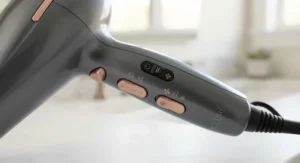
The standout feature is right in the name: this dryer is engineered specifically to reduce arm fatigue during long styling sessions, which matters more than most spec sheets admit when you’re holding a dryer overhead for ten or fifteen minutes trying to lift roots section by section. It pairs that lightweight body with custom heat automation, five heat and three speed settings, two concentrators, a diffuser, and a smoothing comb attachment.
What the spec sheet won’t tell you, but daily users note, is that dryer weight directly affects how consistently you can hold the correct 45-degree lifting angle at the root — a heavy dryer tends to droop toward the end of a session, right when your roots need the most airflow. Here’s what most buyers overlook: the “custom heat automation” system is really just a smarter, hair-type-aware version of the manual dial found on cheaper dryers, aiming to prevent the temperature spikes that cause frizz and flatten lift over the course of styling. Aggregated feedback in this category consistently praises the reduced wrist and shoulder strain, with occasional notes that the premium price is a harder sell if you’re not styling daily.
Pros:
- ✅ Noticeably lighter for long styling sessions
- ✅ Custom heat automation adapts to hair type
- ✅ Comes with five attachments for varied styles
Cons:
- ❌ Premium price for occasional stylers
- ❌ Automation offers less manual control than dial dryers
Positioned around C$200-C$260, this is best justified if you’re drying and lifting your roots most days of the week rather than a couple of times a month.
7. Dyson Supersonic — best splurge for sensitive scalps and fine hair
The defining feature is intelligent heat control paired with Air Multiplier technology that amplifies airflow roughly threefold, which lets the dryer move a large volume of air at a lower, more consistent temperature instead of relying on brute heat. A magnetic attachment system includes a Gentle Air nozzle specifically designed for fine hair and sensitive scalps, plus a styling concentrator, diffuser, and — in newer bundles — a Flyaway attachment that uses the Coanda effect to smooth stray strands.
Based on the spec comparison with every other dryer on this list, the meaningful difference isn’t drying speed so much as heat consistency: the internal sensor reportedly measures airflow temperature many times per second and adjusts it to help prevent extreme heat damage, which matters directly for root lift because overheated roots go limp and oily faster as damaged cuticles struggle to hold a lifted shape. As McGill University’s Office for Science and Society explains, heat causes the water in hair to evaporate, which lets the hydrogen bonds holding keratin’s structure reform in whatever new shape the hair was styled into — meaning gentler, more even heat genuinely does translate into longer-lasting root lift rather than just marketing language. Reviewers consistently cite the lighter overall handling and reduced frizz as the standout wins here, while the recurring, unavoidable complaint is simply the price.
Pros:
- ✅ Intelligent heat control protects fragile, fine roots
- ✅ Gentle Air attachment suits sensitive scalps
- ✅ Magnetic attachments swap quickly mid-style
Cons:
- ❌ Price is far above every other option here
- ❌ Attachments are proprietary and costly to replace
At roughly C$500-C$600, this is a genuine investment piece, and it earns its spot on this list only for buyers whose fine hair and scalp sensitivity make gentler heat control worth paying a premium for.
How to Use a Root-Lifting Hair Dryer for Maximum Volume
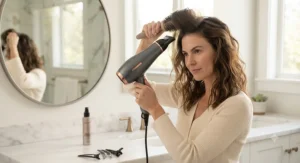
Buying the right dryer only gets you halfway there — technique does the rest, and this is exactly the kind of detail that never makes it onto an Amazon product page. Start on towel-dried, not soaking-wet hair, since a dryer working through excess water spends its energy evaporating moisture instead of shaping lift. Section your hair into two to four horizontal layers with clips, starting at the nape, and work upward so each freshly dried section isn’t weighed down by wet hair falling on top of it later.
For the actual lifting motion, angle the nozzle or brush at roughly 90 degrees away from the scalp — straight up, not backward — and hold each root section for a two- or three-second burst before moving on. This is where a root-lift nozzle attachment genuinely earns its keep: concentrating airflow into a tight stream at the root, rather than letting it scatter across the whole section, is what separates a dryer that merely dries from one that lifts. Finish every section with a blast of cool air before releasing the clip, since cool air is what actually locks the cuticle in its lifted position; skipping this step is the single most common reason volume collapses within the hour.
A quick 30-day habit worth building: clean the removable filter on the back of your dryer weekly. Lint buildup restricts airflow, forces the motor to work harder, and gradually raises the internal temperature — the exact combination that damages hair and shortens a dryer’s working life. Most first-month mistakes are technique problems, not product problems, so give any new dryer a proper two-week trial with the angle and cool-shot habits above before deciding it isn’t working.
Real-World Scenarios: Which Root-Lifting Hair Dryer Fits Your Morning?
Picture three fairly different Canadian mornings. First, a university student with fine, oily hair who washes every other day and needs volume that survives an 8 a.m. lecture and a windy walk across campus on a budget that doesn’t stretch past textbooks — the Revlon One-Step Root Booster or the Conair InfinitiPRO Volume & Shine Pro both make sense here, since both sit under C$70 and are built around exactly this oily-roots, fine-hair problem.
Second, a hairstylist or anyone styling hair professionally most days of the week, where hand fatigue and consistent results across dozens of clients matter more than sticker price — the T3 Featherweight StyleMax Professional or the Shark HyperAIR Rotating Brush earn their higher price tags through lighter handling and auto-sensing heat that reduces the guesswork across back-to-back appointments.
Third, someone with genuinely sensitive skin, colour-treated fine hair, or a scalp condition who has been advised to minimize heat exposure — the Dyson Supersonic‘s intelligent heat control and Gentle Air attachment are worth the premium specifically because consistent, lower heat is a therapeutic consideration here, not just a luxury feature. In each case, the “best” root-lifting hair dryer isn’t the most expensive one on this list — it’s the one built for that specific hair type, budget, and frequency of use.
Common Root-Lift Problems, Solved
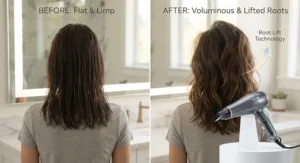
Problem: Oily roots, flat hair by noon. This is a scalp-oil issue as much as a drying issue. Wash roots slightly more frequently if your scalp runs oily, and finish drying with a root-lift nozzle attachment angled straight up at damp — not dripping — roots, using a compact round brush like the Revlon One-Step Root Booster for extra lift right at the source.
Problem: Volume that collapses within an hour. Nine times out of ten, this comes from skipping the cool-shot step. Hold cool air on each root section for three to five seconds immediately after the hot blast; this is what actually sets the cuticle in its new, lifted shape rather than letting it relax back down as it cools naturally.
Problem: Frizz undoing your root lift in humidity. Ionic technology helps here, but a lightweight volumizing mousse applied to damp roots before drying builds a physical scaffold that holds lift even as ambient moisture creeps in — pair it with any dryer on this list rather than relying on the tool alone.
Problem: Product buildup weighing roots back down. Heavy styling creams and thick serums applied too close to the scalp are common culprits. Keep richer products to the mid-lengths and ends, and reserve lightweight, root-specific mousses for the scalp area itself.
Problem: Uneven lift from section to section. This is almost always a technique issue rather than a tool issue — inconsistent section size leads to inconsistent drying time per section. Keep sections no wider than about two inches near the crown, where lift matters most.
How to Choose a Root-Lifting Hair Dryer
- Match barrel or nozzle size to your hair length. Shorter, finer hair benefits from a smaller barrel like the Revlon One-Step Root Booster‘s 1.5-inch brush, which reaches closer to the scalp; longer or thicker hair needs the reach of a full-size dryer paired with a concentrator.
- Prioritize a genuine cool-shot button. This single feature does more for lasting root lift than almost any other spec, since it locks in the shape heat just created.
- Check the motor type, not just the wattage. AC motors, as in the Conair InfinitiPRO Volume & Shine Pro and BaBylissPRO Nano Titanium 2000W, generally outlast cheaper DC motors under daily use.
- Decide if you want a hybrid brush-dryer or a traditional dryer plus attachments. Hybrids save time but limit versatility; traditional dryers with swappable diffusers, concentrators, and a root-lift nozzle attachment cover more styling needs long-term.
- Weigh the dryer before you weigh the price. A lighter unit like the T3 Featherweight StyleMax Professional genuinely changes how consistently you can hold a proper lifting angle through a full styling session.
- Consider heat sensitivity. If you have fine, colour-treated, or heat-damaged hair, intelligent heat control — as found in the Dyson Supersonic — is worth the premium specifically for scalp and cuticle protection.
- Set a realistic budget band first. As the comparison table above shows, genuinely effective root-lift options exist under C$70, so don’t assume price alone signals performance for this specific job.
Best Root-Lifting Hair Dryer for Volumizing Oily, Fine Hair Under C$70
If your entire decision comes down to “top hair dryer for volumizing oily fine hair under $70 CAD,” the two clear answers on this list are the Revlon One-Step Root Booster, for its scalp-hugging compact barrel, and the Conair InfinitiPRO Volume & Shine Pro, for its unusually durable AC motor at a budget price. Both were built with this exact hair type in mind rather than adapted from a general-purpose design.
Root-Lifting Hair Dryer vs Volumizing Mousse and the Flat-Root Styling Technique
It’s tempting to treat a root-lifting hair dryer and a can of volumizing mousse as competing solutions, but honest analysis says they’re solving different halves of the same problem. A dryer provides mechanical lift and heat-set shape; a mousse provides a lightweight polymer scaffold that gives strands something to hold onto once they’re lifted. Used alone, a great dryer on completely product-free hair will still lose some lift by afternoon, because there’s nothing at the root reinforcing the shape once it cools. Used alone, mousse on hair that’s air-dried flat has structure but no actual height to hold onto.
The flat-root styling technique — sectioning hair, applying a small amount of mousse at the scalp on damp hair, then blow-drying each section upward and away from the head before a cool-shot finish — is really the combination of both tools working together rather than either one in isolation. What most buyers overlook is that skipping the mousse doesn’t just mean slightly less volume; it often means volume that fails specifically at the root, since that’s the zone under the most gravitational pull and the first to relax once the heat-set shape starts to cool. For genuinely oily, fine hair, look for a mousse labeled lightweight or root-specific, since heavier mousses formulated for curl definition can add weight exactly where you don’t want it.
Root-Lift Nozzle Attachments Explained: What They Actually Do
A concentrator or root-lift nozzle attachment narrows a dryer’s airflow from a broad, dispersed stream into a focused jet, and that narrowing is the entire point. Broad, unfocused airflow dries hair roughly evenly across a section, which is fine for smoothing but does very little for lift, since it doesn’t concentrate enough force at any single point to push hair up and away from the scalp. A concentrator solves that by directing a stronger, narrower stream exactly where you angle it.
Manufacturers also build dryers with “cool shot” buttons that turn off the heater and blow room-temperature air while pressed, which helps set a hairstyle, and many dryers add “ionic” operation intended to reduce static buildup in hair — though, as Wikipedia’s entry on hair dryers notes, the actual efficacy of ionic technology on frizz reduction remains a point of some debate among researchers rather than settled fact. On paper this means a root-lift nozzle plus a genuine cool-shot function will do more measurable work for lasting volume than ionic technology alone, even though ionic branding tends to dominate the marketing on the box. If you’re choosing between two similarly priced dryers and one lacks a narrow concentrator attachment, that’s the bigger gap to worry about compared to ionic claims.
Common Mistakes When Buying a Root-Lifting Hair Dryer
The most frequent mistake is choosing based on wattage alone. A 2000-watt motor sounds objectively better than a 1875-watt one, but for root lift specifically, nozzle shape and the presence of a real cool-shot button matter more than an extra 125 watts — the Revlon One-Step Root Booster, at a fraction of the wattage of the BaBylissPRO Nano Titanium 2000W, still outperforms it for fine, oily roots because of barrel size, not power.
A second common mistake is buying a full-size traditional dryer for genuinely short or fine hair, where a compact hybrid brush-dryer will actually be easier to control and less likely to blow hair flat from too much distance. A third mistake is ignoring attachment compatibility on premium dryers like the Dyson Supersonic, where replacement attachments are proprietary and considerably pricier than universal third-party parts that fit cheaper dryers. Finally, plenty of buyers skip checking for a certification mark altogether, which matters more than most shoppers realize and is covered fully in the safety section below.
Long-Term Cost & Maintenance
Sticker price is only part of the real cost of a root-lifting hair dryer. A budget AC-motor dryer like the Conair InfinitiPRO Volume & Shine Pro, cared for with regular filter cleaning, can reasonably be expected to outlast several cheaper DC-motor dryers bought back to back over the same period, which changes the actual cost-per-year math considerably. On the other end, a premium pick like the Dyson Supersonic carries a steep upfront cost but a genuinely long usable life and a multi-year warranty in many markets, spreading that initial investment across a decade or more of daily use.
Where ongoing costs creep in is attachments and consumables: universal diffusers and concentrators for standard-fit dryers typically run in the C$10-C$25 range and fit multiple brands, while proprietary attachments for premium systems like Dyson’s magnetic mount cost meaningfully more and only fit that one ecosystem. Add in a lightweight root-lift mousse, replaced every couple of months, and the true annual cost of maintaining reliable root volume includes more than just the dryer itself — worth factoring in before comparing sticker prices side by side.
Safety, Regulations & CSA Compliance in Canada
Before comparing features further, it’s worth pausing on a less glamorous but genuinely important point: electrical safety. As Health Canada notes, electrical products that plug into an outlet must meet Canadian national safety standards and be certified by an accredited certification body, and shoppers should always check for certification marks such as CSA, cUL, or cETL before buying. Hair dryers specifically fall under CSA’s household appliance safety standards covering skin and hair care devices, so a visible certification mark on the packaging or the unit itself isn’t just a formality — it reflects testing against Canadian electrical code requirements.
Beyond certification, a few practical habits matter for hair dryer safety generally: never operate any dryer on this list near standing water, unplug by the plug rather than yanking the cord, and replace any unit with a fraying cord immediately rather than continuing to use it. For root-lift technique specifically, keeping the nozzle a couple of inches from the scalp rather than pressing it directly against hair reduces both burn risk and the kind of concentrated heat damage that ultimately works against the volume you’re trying to build.
Frequently Asked Questions
❓ Does a root-lifting hair dryer work on very fine hair without weighing it down?
❓ What's the difference between a diffuser and a root-lift nozzle attachment?
❓ Can I get real root lift without buying a new hair dryer?
❓ How often should oily, fine hair be washed to keep root volume longer?
❓ Is a more expensive hair dryer always better for volumizing oily roots?
Conclusion
The right root-lifting hair dryer isn’t the one with the flashiest spec sheet — it’s the one matched to your actual hair type, oil level, and morning routine. For oily, fine hair that goes flat fast on a tight budget, the Revlon One-Step Root Booster and the Conair InfinitiPRO Volume & Shine Pro both deliver genuinely targeted root lift for well under C$70. If you want one tool that replaces both dryer and round brush, the Revlon One-Step Volumizer PLUS earns its slightly higher price. Thicker or coarser hair benefits from the raw power of the BaBylissPRO Nano Titanium 2000W, while frequent stylists and anyone chasing hands-free consistency should look at the Shark HyperAIR Rotating Brush or the featherweight comfort of the T3 Featherweight StyleMax Professional. And for sensitive scalps or fine, heat-fragile hair where gentler technology genuinely matters, the Dyson Supersonic remains the category’s clear splurge pick.
Whichever one you choose, remember that the dryer only does half the job — a proper 90-degree lifting angle, a real cool-shot finish, and a lightweight mousse at the root will do more for lasting volume than any single spec on a box. Combine the right tool with the right technique, and flat, oily roots by noon stop being a daily inevitability.
✨ Ready to stop fighting flat roots every single morning? Check current prices on today’s pick and give your routine the lift it’s been missing! 🚴♂️⚡
Recommended for You
- Hair Dryer for Oily Hair: 7 Best Picks in Canada 2026
- 7 Best Moisture-Lock Hair Dryers in Canada 2026
- Hair Dryer for Dry Hair 2026: 7 Proven Picks to Stop Frizz
Disclaimer: This article contains affiliate links. As an Amazon Associate, I earn from qualifying purchases. If you purchase products through these links, we may earn a small commission at no additional cost to you.
✨ Found this helpful? Share it with your friends! 💬🤗
